
The CTE Educator’s Guide to Launching a High School Drone Pathway
There is an exciting shift happening across career and technical education (CTE) pathways nationwide. To see how hands-on aviation technology is expanding to additional schools, read our breakdown, “The Next Evolution of CTE Educational Drones.” Drones are actively transforming industries like precision agriculture, infrastructure inspection, surveying and public safety. By bringing unmanned aerial vehicles (UAVs) into secondary education, educators give learners direct, hands-on access to fast-growing STEM career fields.
However, starting a high school drone pathway comes with practical questions: What if educators do not have aviation backgrounds? How do you keep 20–25 learners engaged when only one drone is in the air? What happens when a drone crashes?
This guide breaks down the core questions educators ask when launching a drone program — which were explored in depth during our recent session, “10 Questions CTE Instructors Ask About Drone Programs.” Discover how the Drone Pathways: Foundations of Flight Operations program simplifies implementation for secondary educators.
1. What If Our CTE Instructor Does Not Have Aviation or Drone Experience?
Educators do not need an FAA Part 107 certification or a background in aviation to teach Drone Pathways.
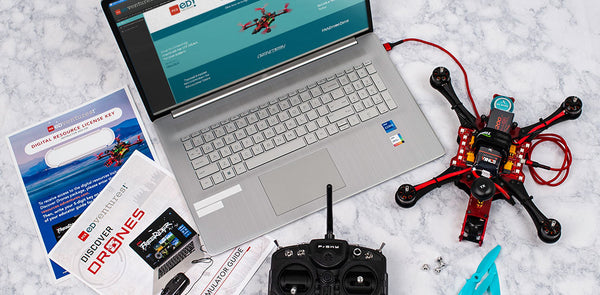
The program includes a step-by-step digital onboarding course that guides educators through unboxing, hardware setup, battery preparation, flight simulator practice and safety procedures. Every package also includes a one-hour product orientation session with a dedicated drone specialist, alongside ongoing product support for the life of the program.
2. Does an Instructor Need a Remote Pilot Certification (Part 107) to Teach?
An FAA Part 107 Remote Pilot Certification is not required to teach the base course. For educational operations, instructors and learners complete The Recreational UAS Safety Test (TRUST).
For programs offering commercial pilot test preparation, the optional Drone Pilot Ground School module covers complex aviation subjects like airspace classifications, METAR weather reports and sectional charts. This structure allows educators to learn right alongside their students. Learners aged 16 and older can take the official FAA Part 107 exam to earn commercial remote pilot certification, opening direct doors to high-wage, in-demand careers before they even graduate high school.
3. How Do Learners Build Flight Skills Without Damaging Hardware?
Before stepping onto a live flight field, learners build muscle memory using the web-based FLEX UAV Flight Simulator (perpetual license included).
The simulator runs directly inside browser environments on Chromebooks, Macs and PCs. Learners connect the included flight simulator controllers to practice core Mode 2 stick inputs: throttle, pitch, roll and yaw. Features include:
-
Guided tutorials: structured practice for pitch and roll, throttle and yaw, and complex maneuvers like the figure-eight.
-
Sprayer challenge: applied precision agriculture scenarios where learners complete Pest Patrol missions simulating crop spraying.
-
Custom course builder: a creative sandbox mode where learners design and share custom obstacle courses with the class.
-
Free flight mode: an open gym environment designed for pairs to practice team communication without scoring pressure.
4. How Do You Keep a Class of 20–25 Learners Engaged?
Drone Pathways uses a Crew Resource Management (CRM) approach. Adapted from commercial aviation, CRM divides learners into structured flight crews of three to five members per drone:
-
Remote Pilot in Command (RPIC): manages the flight controls, executes mission plans and holds operational responsibility for the aircraft.
-
Visual Observer (VO): maintains constant line-of-sight contact with the drone and scans the airspace to alert the pilot to potential hazards.
-
Data Analyst: logs mission details, tracks battery performance and turns flight data into final inspection reports.
-
Hardware/Maintenance Technician: inspects airframe components, oversees LiPo battery safety and handles repairs so the pilot can focus on flying.
-
Payload/Sensors Specialist: coordinates camera angles, targets hover positions and manages sensor workflows during complex flight missions.
While one crew flies or practices maneuvers, secondary crews run flight simulations, plot mission coordinates in mapping tools or prepare constructive peer feedback.
5. What Happens When Drones Crash During Training?
Instructional downtime from crashes is minimized through modular hardware engineering.
The FLEX UAV platform uses a solderless construction model, allowing learners to assemble, disassemble and repair frame components using simple tools like hex drivers. High-wear parts like landing legs and battery holders can be 3D printed on-site using provided STL files. Multi-year refill kits are also available on a single purchase order (PO) to restock extra propellers, motors and hardware.
Comparing Drone Pathways Package Options
Four complete program packages match varying cohort sizes, spaces and funding:
| Package Name | Drone Count | Recommended Cohort | Core Hardware & Tools Included | Best For |
|---|---|---|---|---|
| CTE Starter | 2 FLEX UAV Drones | Up to 10 Learners | 2 FLEX UAV kits, sim controllers, storage backpacks and refill parts | Small pilot programs, CTE intro modules or drone clubs |
| CTE Base | 5 FLEX UAV Drones | Up to 25 Learners | 5 FLEX UAV kits, sim controllers, radio transmitters, storage backpacks and refill parts | Standard CTE classroom cohorts |
| CTE Plus | 10 FLEX UAV Drones | Up to 50 Learners | 10 FLEX UAV kits, sim controllers, storage backpacks and extra batteries | 2 non-concurrent CTE classes |
| CTE Pro | 10 FLEX UAV Drones | Up to 50 Learners | 10 FLEX UAV kits, sim controllers, storage backpacks and Drone Pilot Ground School LMS | Advanced CTE programs targeting Part 107 commercial certification |
6. How Does the Program Comply with FAA Rules and District Safety Standards?
Drone Pathways includes clear protocols designed to meet district risk management standards and FAA regulations:
-
FAA Remote ID Compliance: Programs can establish an FAA-Recognized Identification Area (FRIA) over school grounds or attach compatible external broadcast modules during outdoor operations.
-
FRIA Authorizations: The instructor guide provides step-by-step instructions for establishing a FRIA over school athletic fields or open grounds.
-
Flight Line Boundaries: Procedures show educators how to establish designated safe zones — a safety line for launch, a 15-foot pilot line and a 25-foot spectator line.
-
LiPo Battery Handling: Comprehensive battery guides and videos cover safe balance charging, storage voltages, handling procedures and fire-safe storage containers.
-
Tethered trainer controls: RadioMaster Pocket transmitters allow educators to tether two radios together in teacher-student mode, maintaining an instant override safety net during live flight practice.
7. What Career Pathway Alignment Does the Curriculum Offer?
Drone Pathways aligns directly with secondary Career and Technical Education (CTE) pathways. Hands-on lessons prepare learners for real-world application fields:
-
Precision agriculture: simulated crop spraying, field mapping principles and multispectral vegetative health analysis.
-
Infrastructure inspection: hazard mitigation, line-of-sight navigation and structural surveys through simulated power line assessments.
-
Geospatial and mapping skills: using Google Earth to plan flight paths, identify hazards and mark geographic coordinates.
-
Aviation operations: mastering human factors, closed-loop communication and systematic preflight safety inspections.
8. How Will I Grow My CTE Program over Time?
Proper CTE drone programs follow a progression that allows students to develop flight and technical skills over their years of study. In light of the importance of this scaffolded approach, Drone Pathways will have ongoing expansion modules to expand instructors’ course offerings.
Hardware and Curriculum Expansion Modules
-
Camera and sensor payloads
-
Additional curriculum with scenario-based challenges across various industries
-
Allows instructors to create a full drone CTE pathway that builds on skills learned in previous modules
Bringing Drone Pathways to Your School
Building a sustainable drone program does not require sourcing equipment across multiple vendors. With single purchase order (PO) bundles, educators receive hardware, web-based flight simulator access, reusable tools, safety gear, storage backpacks and aligned curriculum in one complete shipment.
Planning your Implementation?
Schedule a consult with one of our drone program specialists or call us at (208) 343-3110 to get a custom solution.
Resources:




Frequently Asked Questions
Which grade levels is Drone Pathways designed for?
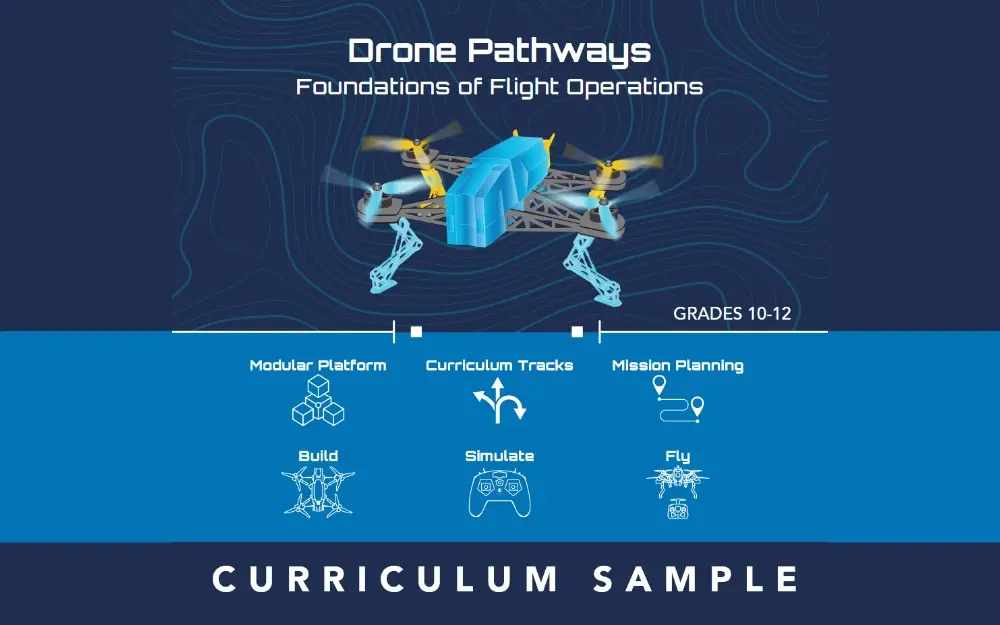
Drone Pathways: Foundations of Flight Operations is built for grades 10–12 in high schools, CTE pathways and technical centers.
How does the curriculum structure instructional time?
The program features 20 core lessons structured for 45-minute sessions, moving learners from mechanical assembly and flight simulation through live outdoor flight missions.
How many learners does the CTE Base Package support?
The CTE Base Package supports up to 25 learners and is priced at $8,995. It includes five FLEX UAV assembly kits, 20 flight simulator controllers, six radio transmitters, five storage backpacks, five LiPo batteries, two chargers and 25 pairs of safety glasses, printed and digital curriculum resources, student pilot logs, and additional hardware.
What technology do learners need?
Each learner needs one internet-connected Chromebook, Windows or Mac device to access the FLEX UAV Flight Simulator and Digital Resource Portal.
Which standards does the Drone Pathways curriculum align to?
The curriculum aligns with state and national CTE frameworks. Confirmed state crosswalks on https://dronepathways.com/#curriculum include California State Anchor Standards, Florida (Unmanned Aircraft Systems Operations 1), South Carolina (Drone Technologies 1), Tennessee (Unmanned Aircraft Systems Pilot), Utah (Unmanned Aerial Systems) and Texas (Intro to UAV Flight).
What does the Drone Pathways curriculum cover?
The 20-lesson progression guides learners through mechanical assembly, LiPo battery technology and lab safety before moving to flight simulation, FAA regulations, Crew Resource Management (CRM) flight team dynamics and visual line-of-sight (VLOS) operations. The sequence concludes with mission planning, capstone practice and a final flight challenge.
Does the curriculum include TRUST test preparation?
Yes. Lesson 13 introduces FAA operational regulations and ethical airspace use, while Lesson 14 guides learners through preparation and completion of The Recreational UAS Safety Test (TRUST) prior to live outdoor flight.
Do learners build the drones themselves?
Yes. Learners assemble the FLEX UAV from a kit of parts using solderless mechanical fasteners, allowing cohorts to assemble, troubleshoot and disassemble the airframes across multiple sessions. All necessary tools and components are included.
Can our school purchase Drone Pathways with a purchase order?
Yes. PCS Edventures accepts school and district purchase orders, allowing programs to bundle hardware, simulator seats, curricula, digital resources and replacement kits onto a single PO. Credit card and check payments are also accepted.