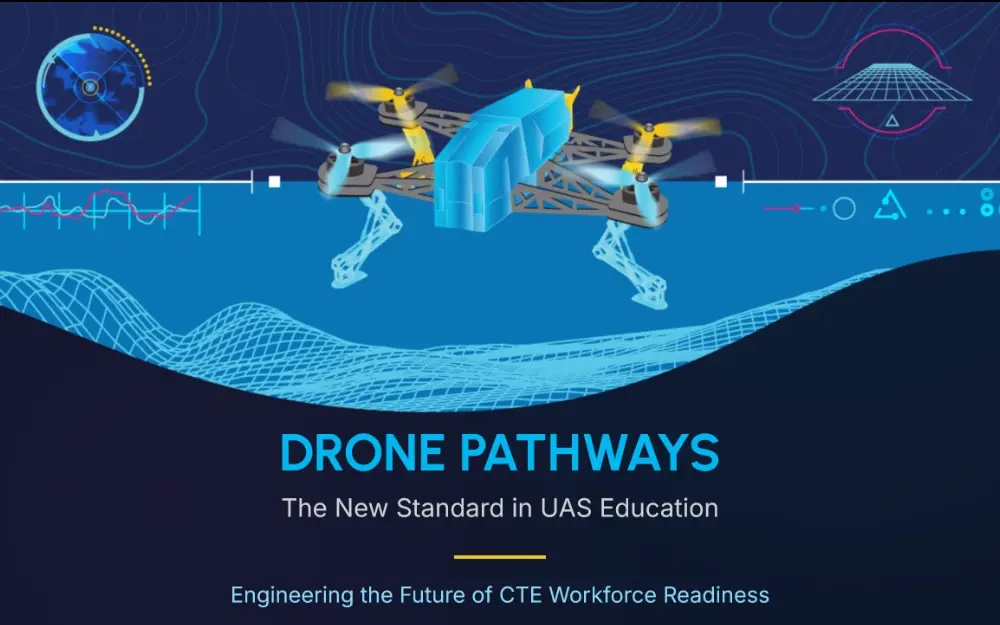
So we are officially recording and you are here for the Drone Pathways uh launch webinar.
So the new standard in UAS uh education. So welcome everybody.
My name is Jan Zatloukal. I'm an instructional designer here at PCS Edventures.
That's a fancy term for curriculum writer.
And uh I have about eight plus years as an educator with experience from elementary school through high school as well as leading a lot of professional development with teachers uh FAA Part 107 commercial drone pilot certific- certification as well.
Um and I've uh been designing lesson plans and things with PCS for about four years now.
So really excited to launch our new Drone Pathways program and share that with you, I've been the lead uh instructional designer on that.
Awesome. So, just a little bit of an agenda, an introduction.
Uh the drone, we're going to talk a little bit about the drone workforce and career outlook.
Introduce the new Drone Pathways program.
Uh we're going to meet the Flex UAV, which we're very excited to unveil.
The Flex UAV is our new uh new drone uh that we've designed here in house from PCS Edventures.
Uh we're going to go a little bit over the CTE standards align curriculum program pricing and packages.
We'll have that live Q&A section and then uh we have got a webinar survey for you and then finally that mini drone giveaway drawing.
So first real quick uh just an audience question here.
If you could type in the chat uh what age group uh do you teach or do you uh generally work with?
While we're getting that, uh, I will start talking a little bit about our drone workforce and career outlook.
So, uh, drone workforce and career outlook here, right?
We're all here for drones, um, to learn more about the Drone Pathways program and this really is a CTE level program designed to prepare your students for real world drone careers.
Uh so the market growth in uh commercial drone market is expect estimated to grow by around 37% each year until 2034.
Uh that's very very fast essentially and then uh very high wage careers right so commercial pilots and aerospace operators can earn up to $215,000 annually.
Uh many of these careers do require advanced training advanced degrees.
However, these Part 107 type careers and introductory drone careers are also uh very good uh paying jobs.
Right out of high school, students can get their drone license uh at 16 and then they can immediately begin earning money and working towards that career.
So, it's a it's a very big and growing industry. There's a lot to do.
You can be a drone pilot. You can be a you can be a drone engineer.
And so the industry is shifting and we really want to prepare these students for high demand technical careers.
And drones are a really great way to get them excited to get uh butts in the seats, so to speak, and get them really excited about these technical careers.
So I see we've got the chat running. So awesome. We've got 9 through 12, 11, 12, 7 through 12. Excellent. Yes.
So, we've got a lot of high school uh teachers in here, which is great uh because this is very very uh designed towards that high school age group.
Awesome. K through 12. Right.
So, we do have a lot of um high school teachers in here and working with high school students.
So, you're in the right place for sure.
And so, for this second question, uh have you ever used drones with your students before?
Few times. Few times. Yes. It's never. Okay. So, I'm seeing we've got a bit of a mix.
I'm not seeing a whole lot of people who have a dedicated drone program yet.
And that's the key word "yet" because Drone Pathways could definitely be that uh drone program for you.
First time this year. Nice. Excellent. I hope it went well. All right.
So, it looks like we've got a good mix of mostly upper, middle, and high school teachers in here.
Uh, from what I can tell here, the the vast majority of us have used drones very sparingly, if if at all.
So, you're in the right place. We are going to talk about how you can make drones uh make a big impact in your classroom for your students.
Okay. So, as I was kind of saying before, drones are a really great way to get students started.
Not every student has to end up as a drone pilot, but it is a great way to get them started on these technical career paths and uh learning about what they're interested in through that drone flight.
So, some various uh drone applications that we're seeing in industry.
Uh this is an what we call an emerging industry, right? So, we are seeing drones being used in new ways every year.
And so it's really exciting to be able to be a part of something and it's a really great way to get your students involved in technical careers by showing them that drones are being used in new ways every single every single day really.
Um so things like a bridge um inspection, a drone can fly underneath that bridge, hover in place and take high resolution photos of that without putting people at risk.
Uh in agriculture, you have farmers that need to count uh healthy plants uh in a 500 acre field.
Um that's going to take days to walk around or to even drive around it, right?
You could fly over it in a in a plane, but you're not going to get good pictures. Helicopters are expensive.
So, you can take a multi-rotor drone and fly over that entire field in a grid format, taking hundreds of photos to create a really detailed map.
Um, a problem with a storm, a power line is down in a dry field.
Uh, you you really can't you don't want human beings going anywhere close to that.
So, a drone can quickly fly over that hazard uh and assess the damage, identify fire risks and things like that.
Um, and then a filmmaker wants a bird's eye view of a car chase scene through a narrow city alleyway.
A small agile drone can just fly right through there. Uh, that a helicopter is not really going to fit through, right?
So drones and entertainment and photography as well.
So, lots of exciting applications to talk about with your students.
And so, this is where our Drone Pathways program comes in.
We uh have built before we were working with the Discover Drones platform uh and that's the RubiQ drone.
So, we have over 10 years of experience as a company working with drones and we knew that it was time to build a new platform for drones as they are evolving so quickly.
So, we've got this uh Drone Pathways kind of explainer video uh that I'm going to let play for a second here.
Just a just a couple minutes. And this does a great uh job of overviewing what we've created with this new Drone Pathways curriculum.
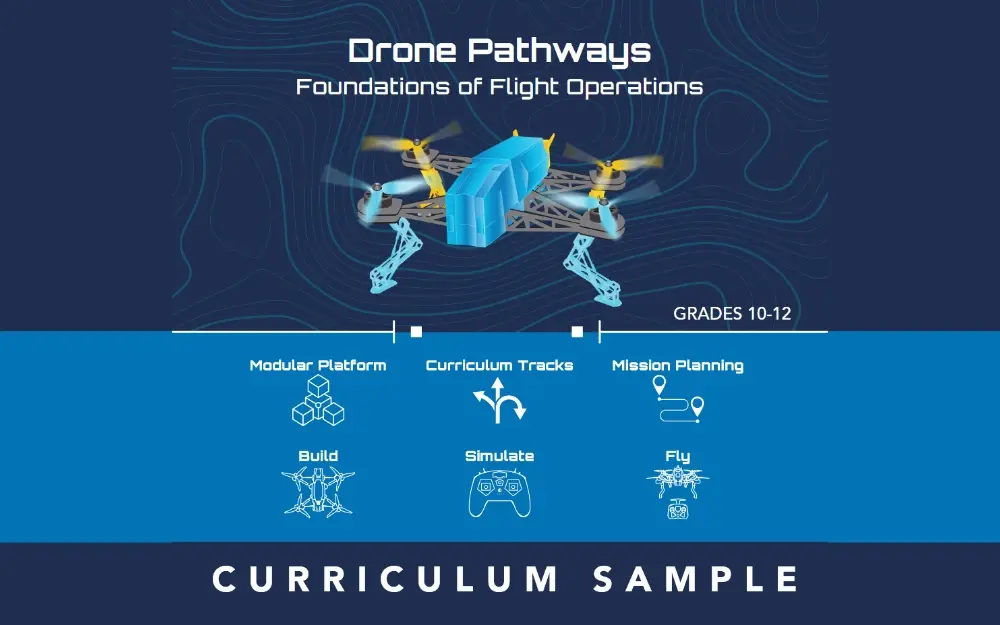
Chart a new path to exciting drone careers with Drone Pathways: Foundations of Flight Operations.
Transform your CTE classroom into a dynamic aviation hub designed for grades 10 through 12.
Learners master hands-on UAV assembly and real world flight through our expert three-phase scaffolding.
Operating and professional flight crews, learners master crew resource management.
They engage in problem solving and collaboration as they cycle through roles to build practice on the flight simulator and fly real drones.
Drone Pathways comes with 20 45-minute standards-aligned lessons that provide a turnkey solution for educators in CTE settings.
Because the Flex UAV drone is fully modular and requires absolutely no soldering, it can be assembled and reassembled, making it highly reusable with each new group of learners.
Learners also prepare for and complete the FAA trust test and can take their skills even further with our optional Part 107 test prep add-on, building real career ready credentials in one of today's fastest growing fields.
The curriculum is aligned to CTE standards across multiple states, ensuring learners gain skills directly applicable to high demand drone careers.
Now, let's unpack the Drone Pathways materials. The number of boxes depends on the kit you purchase.
Inside the boxes, you'll find the instructor guide, which is a comprehensive resource that makes it easy for educators to prepare for each lesson.
Within the instructor guide, you will also find a digital resource license key, which grants access to all of the digital resources that come with the program.
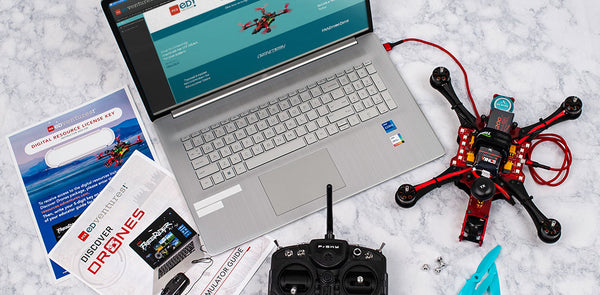
These include digital copies of the curriculum, accompanied slides, instructor onboarding resources, assembly instructions, and the Flex UAV flight simulator.
The box also contains printed pilot logs.
To keep everything powered, we've included a surge protector, and all necessary connection cables, a cell checker, a battery killer to assist with safe lipo battery disposal, safety glasses, simulator controllers, lithium polymer batteries, battery chargers for safe powering, battery safe bags for charging and storing your power supplies.
For drone assembly and maintenance, the kit includes two different sets of Flex UAV propellers, the 7-inch three-blade set and the 7-inch two-blade set.
You will also find a nut driver and a hex driver for assembly.
You'll also find a dedicated radio controller for the instructor.
Finally, you'll receive your Flex UAV drone kits, each to housed in a convenient backpack.
Inside each backpack is the student radio controller, the Flex UAV drone and a bag containing the landing gear.
In addition to those items, there are sockets, screws, standoffs, motor plates, and the motors themselves.
Educators will simply need to provide one internet-connected Chromebook, Windows, or Mac device per learner.
This device will be used to access the assembly plans and the Flex UAV flight simulator.
For more information about this career focused program, visit edventures.com or give us a call to connect with a STEM program expert.
Awesome. So, as you can see, this uh this drone kit comes with everything you need in order to start up a drone program.
So, we're we're operating under the assumption that you have never flown a drone before.
You don't need lots of experience uh flying drones or building them.
Uh it comes with everything that you need and so it's designed as a turnkey solution to come with everything that you're going to need in order to uh start up your drone program and then to implement these 20 45-minute lessons.
Uh there's a really good CRM focus in the curriculum.
So it's really applicable to every single uh to every different profession really because it's crew resource management uh training to build professional industry habits and skills.
Uh so the flight sim is included as well and this is Chromebook compatible.
Uh the flight sim training is going to have real time has real-time progress tracking.
Uh your students can sign into that and get started right away. It comes with the controllers to operate that flight sim.
And that flight sim does everything to model the uh Flex UAV drone that we'll be talking about in just a moment.
So here's that Flex UAV. This is uh purpose-built for CTE.
Uh this is really going to uh curriculum specifically designed uh for the Flex UAV drone.
So the drone and the curriculum are merged together. Uh and it works very well together to get students ready to fly.
Uh it's very durable uh student buildable which means that you can take it apart and then use it the with your next class uh your next semester or your next group and then it's modularly designed.
So we'll be having future hardware expansions where we can uh take pieces off and put new pieces on uh say a photo video camera with a tilt gimbal and things like that as well.
So in the future we will have uh hardware expansions that will also come with curriculum expansions to show you how to not only build that but how to apply that in the uh career fields as well.
Um and it also is autonomous waypoint mission planning capable.
So this drone can be coded to fly on an autonomous waypoint mission planning plan. So yes, it's that futurep proof that modular design.
Uh it's built for expansion. And that means you can rapidly grow your existing program with curriculum and hardware add-ons to this base program.
So you can start with this Drone Pathways: Foundations of Flight Operations.
You can add our optional Part 107 test prep course and then uh once the curriculum and hardware add-ons come out, you can add those out and expand your program as you grow.
A little bit about the Flex UAV's anatomy here. Um you can see we have various 3D printed parts as well.
We will be releasing those uh designs to you too. So we know a lot of uh CTE programs already have 3D printers.
So we'll be releasing all of those designs as well.
Uh so you can see that the uh the blue pieces there that on the front and back those are uh 3D printed designs and those house various components that I'll be going through as well as the landing gear.
Those are also 3D printed. Uh we have a carbon fiber frame and then uh all of the other pieces on here.
So the arms and the motors. Um we have our flight controller. An optical flow LAR sensor is attached at the bottom.
Uh that helps for stability and uh helps to stabilize the drone and keep it uh moving in the air as well.
And then you have your electronic speed controllers uh housed in the motors there.
And then your GPS module uh radio frequency receiver and your LED screen.
So the LED screen is there to provide you information on things like battery life and so on and so forth.
So we've got all uh all of your Flex UAV. That's kind of our anatomy of that drone.
And uh so what the students do when they receive the kit is they go through our digital build plans and assemble that drone through the lessons.
And so that goes right into our CTE standards-aligned curriculum.
We are aligned currently to five states CTE standards frameworks. Uh we definitely will be aligning to other frameworks as we as we build out this program as well.
My goal is to eventually align to every single state, but as you may imagine, that takes a little bit of time uh to get that in.
So, we uh are currently aligned to California, Florida, South Carolina, Tennessee, and Utah.
And these uh these five states have great curriculums for drones.
And these are all introductory courses. So, this current drone module is aligned to an introductory drones course.
Like I had mentioned previously, you don't have to have any prior experience to begin teaching.
Some of the curriculum resources that come with this kit are your instructor guide.
That's going to have all of your lesson plans as well as all of your technical documentation in there.
So that instructor guide is going to teach you everything you need to know about how to build out this program, right?
It also includes that technical documentation.
So, we have within the technical documentation in the appendix, we have a lipo battery charger guide, a radio controller guide, a flight sim guide, and then all the FAA guidance that you'll need in order to fly that drone.
We also include the student pilot logs.
So, each student gets a pinted pilot log and then on our digital resource portal, we have uh digital versions of both of these documents, so you can print out new ones if you'd like.
Uh but this pilot log is going to go through lesson by lesson and give the students uh questions and things to fill out diagrams.
Uh it also houses the pilot log uh checklist. So the flight checklist in the uh back.
And then uh we've got all of our digital onboarding resources as well. So we built out an entire onboarding course for the instructor.
It's an LMS style course and it goes step by step from unboxing your drone to preparing on the flight sim to getting your flight simulator ready to all the way to flying that drone and practicing uh before you get started with your students.
So we that onboarding session is going to take you through everything you need in order to to get you moving and get you prepared fully prepared uh before those students uh step in the door.
The uh digital onboarding resources are on our resource portal as long as as well as digital assembly plans and slides.
So we have daily slides that go step by step and follow along with the instructor guide and pilot log through every single lesson and have images, videos, and all the information your students need and you need to successfully move forward through the course.
It also includes our flight simulator that we've designed inhouse which I had mentioned previously does work with Chromebooks.
Uh it is web- based and so once you get the flight simulator up and running, there's nothing to install.
You don't need a gaming computer. You can just get started on that with Chromebooks. You plug your uh flight sim controller in and get started.
So this is uh one I think a lot of you are probably interested in. I saw in the chat there the program pricing and packages.
We have various packages for this CTE program depending on the size of your class and how many students you have.
So we have a CTE base package which is a five drone package uh for $8,995 and that comes with five drones.
So the idea is your students would be working in flight teams. That's where that crew resource management piece comes in.
So they're working in flight teams.
You have your five drones, each housed in a backpack, so you can easily take it out to the flight field.
Uh you've got your radio controllers, SIM controllers, safety glasses, uh batteries, chargers, and then a bunch of extra legs, uh landing gear legs and props, and all of that.
Comes with your ED guide, your pilot logs, and then full access to that digital resource portal.
Uh like I had mentioned previously, once you purchase these materials, these materials are yours to keep.
You can just keep using them over and over each semester, right? The drones are very repable, very reusable.
Uh you can just keep using those with every semester as you move forward. And so that's kind of our CTE base package.
It's designed for about 20 a class of about 25 students. We also have different configurations.
And I'm not going to read every uh word on this uh slide. Don't worry, we will send you all the slides at the end of the of this presentation.
So, we have our CTE starter kit which starts at about right under $4,000 and that's for a two drone.
So, that's about 10 students but comes with everything you need for that smaller class size or maybe you're using it as an afterchool activity. Uh that that'll fit in really well there.
We have the uh aforementioned CTE base kit.
Uh we have our CTE plus which is 10 drones and everything you need.
So that's uh basically built to to use with two uh non-concurrent classes at a time.
And then your CTE pro kit. So that's your 10 drones and everything you need plus the Part 107 uh prep course.
So that comes with the full uh Part 107 prep course as well with it included.
Uh you don't have to buy the CTE Pro kit to get that Part 107 prep course. You can purchase that separately.
So, you could get that CTE starter kit and get the uh prep course as well.
But the CTE Pro, that's about right under 23,000 and that's for that 10 drones. Comes with everything you need uh including a bunch of extras as well.
All right, so I think I did a pretty good job of running through uh that information quickly. If you've got any questions, write them in the chat.
Okay, how much is the prep course?
So, the CTE prep course is done through drone pilot ground school and so that comes in various seats. Yes. So, 1750 for 25 seats and then 3,000 for 50 seats.
Uh yes, and we do also have uh they they have an ability to purchase individual seats as well if you have a smaller group.
So with the Part 107 uh each of those seats are with the student uh they're paired to a specific student.
So that would be a reoccurring uh cost is in terms of the students uh for a new class um because they realize that sometimes not every single student finishes their Part 107.
Maybe something comes up and they are unable to finish the course in that given semester.
So they get lifetime access to uh they can also go back into the Part 107 prep and read through the information again uh to get reertified as your Part 107.
Any other questions, comments?
The average lifespan of the non 3D printable parts of the drone. That's a great question for our R&D engineer Chris. Yes. So, it looks like these can last a lifetime.
Yes, it's a carbon fiber frame. Yeah, that carbon fiber frame would be difficult to break.
I'll address the the size on the backpack. Yeah. So, it's a um it's about a 60 L backpack and it's about half the size of the backpack and it also houses the radio controller and the spare parts um like your propellers and your batteries and things like that.
Uh Eileen, any grants in Pennsylvania? We can definitely follow up with you on uh Pennsylvania specific grants. Absolutely.
And then your uh question on the indoor versus outdoor. So these are um mostly designed around the outdoor space.
They do have an optical flow and LIDAR for um times that you may have weather or wind and things and you want to keep your program running inside of like a gy- gymnasium like somewhere you may play basketball or volleyball with a high ceiling.
Um but yeah, we're definitely going towards that CTE, you know, um practical application. So for mission planning and GPS used primarily outdoors.
Yeah. Yeah.
Primarily outdoors um can in a pinch be used indoors with additional precautions for sure.
And the uh initial curriculum 2 does have a autonomous waypoint mission planning preview lesson.
So we have that on our digital resource portal. So, at the very end, it's kind of a bonus activity there that we have for autonomous waypoint mission planning.
And then future add-ons are going to explore that a lot uh more in depth.
And we're going to have curriculum and hardware add-ons that will explore that a lot more in depth.
But this specific uh this drone can do autonomous waypoint mission planning. Um and so we do have that that uh preview.
Hey Jan, can you speak a little bit more to kind of our direction for the future hardware and curriculum expansions?
Yes, I can. Uh, so what I can share right now is we're in the process of exploring uh a tilt gimbal with a photo video camera.
Um, so that's what we're exploring right now is the hardware for that and then how to uh get that properly mounted.
And so we'll be creating a curriculum package based on on that tilt gimbal and uh photov video camera.
And so uh that that add-on package um one way to kind of envision that would be with your drone foundations course and with with your Drone Pathways foundation course and your Part 107 plus an uh photo video add-on package.
You could essentially have a full semester drones one course. So, that's kind of where we're headed.
Um, subject to change. I'll I'll caveat that. Subject to change in terms of the add-on package, but that's the direction we're currently headed right now.
There there are a lot of things that we can do with this being a modular platform.
So, uh really the sky's is the limit so to speak, um pun mostly intended there and so uh yeah there are a lot of things we can do this being a modular platform um there are a lot of ideas that we have so we're trying to figure out what uh what kinds of pathways we can go down, and and any any customer feedback would be extremely helpful on that, uh basically what what you all want to do with this drone.
Yes we will continue to support Droneology.
So, no renewal package, no. Um, we will have options for a uh kind of a refill package, right?
Where you can get additional components as in terms of consumable components, things that will eventually need to be replaced, things like batteries that eventually will lose their uh full charges and and whatnot.
That's not going to happen probably after one or two a few semesters of use, but eventually you'll you'll want some new batteries and things.
Uh we'll have landing gear and then a-la-carte uh various components as well. Um we're looking into some various repair options too.
Uh but in terms of lessons and content and things uh renewal yeah renewal packages, you're not going to need to renew anything in the drone foundations package.
Yes, we are uh exploring ability to use uh with programs like ArcGIS that would potentially be something we use uh with this photo video camera.
We're also exploring an add-on for things like uh more advanced functions like photogrammetry.
Um, we know that's going to be somewhat of a niche case for a lot of people, but uh, many people in the a business or or those kinds of pathways are definitely going to want something like photogrammetry, which would definitely include something more like ArcGIS.
Yeah, one of my backgrounds is in Earth science, so I'm all for it.
Yes, this this uh Drone Pathways program is uh is very CTE focused.
Um, this one we really tried to make all of the durable skills and soft skills applicable to students no matter where their careers will take them.
Uh, that's a big focus in the program. Um, and then obviously the technical skills, but we definitely want to make uh we want to prepare these students for technical skills and then those soft skills, durable skills where they can use them transferably through any uh any career path.
Orthomosaic. Uh we're not quite sure if that's going to fit into this initial photo uh this initial add-on, but we're still ex- we're still exploring it.
Uh once we choose the hardware and the various platforms that we're uh working on, then we'll definitely be able to answer more of those questions.
And uh keep your eyes on the lookout for emails from us uh in the following few months or so, uh several months or so, we will likely be doing another webinar to announce our add-on.
Excellent. Well, we're grateful to have you all.
And yeah, so our live giveaway, we are going to randomly select three winners for our mini drones.
Uh these mini drones are really a great way to get your students introduced to drones.
Uh they can be flown indoors, they can be programmed, and we do have curriculum already that goes along with these uh mini drones as well.
So if you get one, you have fun with it, uh please reach out to us and check out our Ready, Set, Drone! program.
That's a great introductory drone course for uh some of our middle schoolers and kind of our earlier learners a little bit before the high school, but it's a great way to get your feet wet with drones and uh start having fun and learning about how to how to operate them.
Uh Moira, if you would randomly choose our three winners, please.
Congratulations, Amber. Winner number two is Deborah Moss. All right. Excellent. Winner number three, Eileen. Congratulations.
So, yes, to all of our uh winners, thank you. Congratulations.
And to everybody for joining us, thank you so much.
Uh again, my name is Jan Zatloukal. Our company is PCS Edventures.
We really uh we really care about STEM and getting uh the CTE program off the ground.
Uh we're we're just very excited to be able to announce this Drone Pathways: Foundations of Flight Operations program with you all here today.
Thank you everybody and have a great rest of your day.