So, thanks everyone for joining us today.
We're going to have a really fun session and hopefully show you guys some awesome tools to bring into your program.
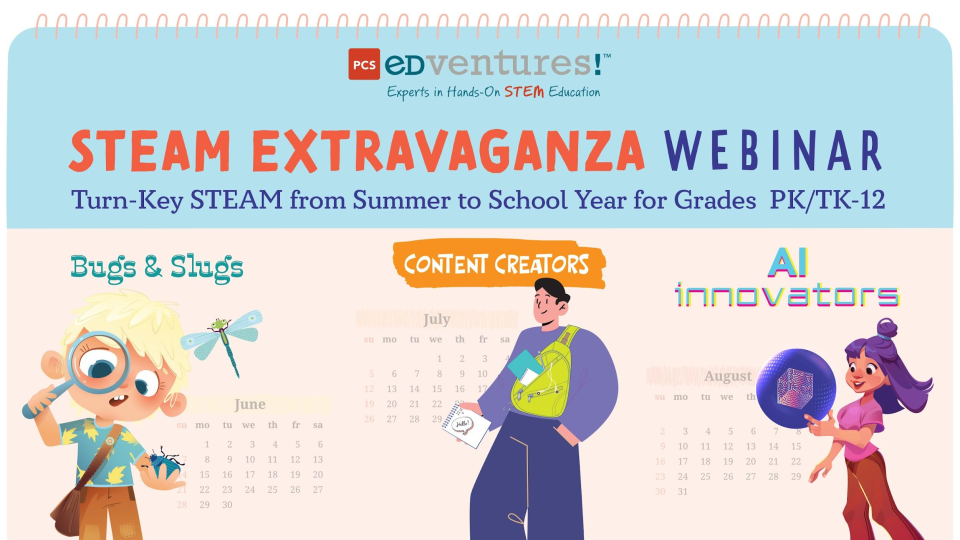
So this is the STEAM Extravaganza webinar.
So the idea here is that we're going to show you all different kinds of enrichment solutions that you can bring to your afterschool program or summer camp or perhaps as an additional enrichment that you can do in the classroom.
They're really flexible in their learning environments so they can fit into and they're all very turn-key.
And we're going to highlight three of our newer offerings.
So, we have our Bugs & Slugs camp for grades 1-3.
That one is already available and we've already had some folks really come back to us and talk about how much they've enjoyed it.
We also have our Content Creators and AI Innovators packages and those are going to be coming out in the May time frame.
And we'll have Beth go through those in more detail and give you guys a little sneak peek as to what those are going to be all about.
So both Beth and I are going to be presenting today.
I am a specialist for PCS, so I work with STEAM programs throughout the Northeast and nationally, in fact.
But yeah, help to outfit them with all sorts of good STEAM solutions for their learning environment.
And then also presenting today will be Beth. And Beth is an instructional designer.
So, she works with our development team to put out all the awesome curriculum that we have.
She is in fact the creator of Bugs & Slugs.
So, she will be more qualified than anyone else to talk about all that is Bugs & Slugs.
A little breakdown of how we're going to progress through it.
So, we already gave a little bit of a welcome there, but we'll show you kind of a company background and what PCS is all about.
I'm going to review kind of our structure and how we put together STEAM enrichment programs.
Beth is then going to highlight all of those new programs that we have for this year.
And then we'll do a wrap-up and Q&A at the end.
And then the very exciting part that you'll want to hang on for is that we're going to do a giveaway.
And so we'll be giving away your choice of a full Bugs & Slugs program or a gift card to be able to select a program of your choosing.
So definitely hang on and hang on till the end.
We'll try to be as concise as we can, but stick around.
So, a little background about PCS.
So, a very interesting name. It is in fact an acronym. It's Pat's Computer School.
There's a gentleman here in rural Idaho who decided to bring computer science to kids at a time when a lot of universities, high schools, what have you, were not teaching that subject.
And so he found that having hands-on experiences for kids was a really great way to cement the concepts that you're trying to get across.
And so he created and those learning centers were distributed throughout the Northwest.
And we've since morphed into a pure curriculum product development company with the idea being that everything that we've learned from the years of R&D and experience working with kids is able to be translated to your program and have ready made stuff good for you.
As I mentioned, hands-on education is what we're all about.
And we also do kind of long solutions so not just a single experience but being able to outfit an entire program over the course of a school or a summer.
Just a quick overview of some of the different partnerships that we have.
So, we work locally with the Idaho STEM Action Center and the Idaho Out of School Network, also known as ION.
So, we do have some organizations we work with there.
And then more nationally, we've worked with the Air Force JOTC to implement our Discover Drones program, which is a quite technical drones course.
And we also have worked with the Technology Student Association to do their drones competitions.
And then finally our relationship with the Id— the Iowa STEM council.
So they have done an annual program and selected three of our different packages to be implemented across the entire state of Iowa.
So certainly not a comprehensive list, but some of our more prominent partnerships that we've had over the years.
We're also quite broadly approved.
So for those of you that have to go through co-ops or your procurement process may be a little bit more prickly, we are approved on TIPS and buy board and choice partners.
And then for those of you in Texas, we're also approved with Harris County Department of Education or HCTE.
And we are a sole source vendor. We are the one and only creators of the products that we have.
So, we definitely want to make sure that your ability to get our products is as smooth and seamless as possible.
And part of what we're going to cover today is really the gamut that these packages run from very low tech all the way up through high-tech.
So, some of the examples here we have our BrickLAB products.
Think a building brick, a Lego equivalent, where we pair it with various curriculums like BrickLAB Zoo.
We're doing animal adaptations, learning about different environments that animals thrive in.
And then we have Famous Architecture, BrickLAB Genetics.
So lots of different subjects all using building bricks as kind of the basis for the lessons.
And then we have, kind of progressing up the tech chain, something like Discover Podcasting.
So this is a program where we actually show students how to create podcasts from the very genesis of the idea of what they're going to talk about all the way through the technical process of recording and editing and perhaps even publishing if they so choose.
And so that would represent kind of that middle spectrum.
And then in terms of the high-tech stuff we have something like our Drone Designers package.
And in this one, they're actually costuming drones and then coding them to perform a drone dance routine, if you will.
So, definitely very much like the essence of STEAM, bringing in all of these different areas of focus and then having one kind of set experience at the end that culminates that curriculum.
So, certainly not a comprehensive look at all of our different offerings.
We will soon have about 40 different kits to choose, but just to show you that we kind of run from, completely screen-free all the way up to high-tech.
We know that especially in these last few years, kids have gotten screen lots of time on tablets and phones and the like.
So, sometimes it's good just to unplug and be able to learn with their hands.
But to also teach those technical skills, we have some curriculum that caters to that as well.
So, we're going to cover real quick what our STEAM enrichment programs are all about.
So, this little graphic here kind of shows you a little snippet of the different subject areas that we touch upon and some of our more popular offerings, but each of them follows this format.
And so, if you understand this one graphic, you will understand kind of everything thereafter.
So, each package that we're going to talk about has materials for up to 30 kids at a time.
So, you certainly don't have to have 30 kids, but that's a pretty round number for most programs.
And then the curriculum that goes along with it is 1-hour lessons.
For preK and TK, we have 24 30-minute lessons. Still comes out to about 12 hours.
We also have lesson extensions in there.
So, if you guys are wanting to run a little bit past those 12 hours, we have lots of different fun offshoots to go into.
But these curriculum packages are really designed to be turn-key.
So, as easy as they can be to implement.
They're designed for instructors of essentially any experience level.
So, we know often times in after school especially, you don't necessarily have someone with formal teaching experience or with a teaching degree.
That's just fine. We assume that they do not have any of that kind of experience or have any experience doing these kinds of lessons.
So if they're covering drones or they're covering stuff about the ocean, they don't have to be an oceanographer to understand what it is that we're getting across in the lessons.
And then additionally, we ensure that they're all aligned to educational standards.
So, we'll cover a little bit about that here in just a second.
But kind of rounding this out, we also want to make sure that you guys are massively successful with implementation.
And so, by default, we offer about an hour-ish long orientation webinar with any purchase.
And so the idea is that your staff are able to jump on with one of our development folks like Beth and get a good synopsis of what that curriculum is going to be about, what materials are in the kit, any kind of common questions that come up, technical concerns.
So really make sure that you guys feel supported and that you have a good point of contact as you go to implement on the alignments front.
So we really touch on those soft skills or durable skills.
And so ensuring that kids are developing communication skills with any of those translatable skills that are applicable across all different career paths.
And in addition to that we hone in on some of the more specific standards frameworks like NGSS and ISTE.
We also have certain programs that touch on national core art standards such as our Discover Podcasting program.
And then we have certain common core state standards where applicable and for all of our products.
If you go to our website you'll see on every web listing we have a comprehensive breakdown of the entire standards and alignment for that given.
In terms of the curriculum itself, it comes in the form of an instructor guide.
So, your instructor would get a spiral-bound manual that has those 12 one-hour lessons in it.
We also often have student portions. There's a student workbook, if you will.
So, that's definitely the case for Podcasting where we have what's called our podcaster pad where they're actually doing kind of graphical note taking and progressing their way through the curriculum.
We also have what's called our digital resource portal.
So everything that we provide in print, we give to you in digital format among a few other choice offerings.
And I'll touch on that digital resource portal here in just a second.
In terms of the way that we structure our curriculum, it's really well laid out and really easy to follow.
Again, we design it for any kind of educator.
They don't have to have that formal experience to be able to use it.
So each day is going to show you which materials are needed out of the kit kind of in a rough approximation of the schedule.
So how much time to allocate to each part of the activity.
Then it goes through with some different prep that may need to be done, STEAM connections, background information.
So it's all very graphically and neatly organized to make sure that it's easy to use.
And then the meat of the lesson also has little icons in it where we'll show you if there's an entire group discussion or small group discussion or if things are being done individually with students and that really helps with the kind of flow of the lesson as the instructor is going through it.
And we'd be happy to share curriculum samples for anyone.
Those are also readily accessible on the website at each of the web pages.
You can go and visit and see all the different curriculum offerings that we have and get kind of a snapshot of what that lesson is all about for our digital resource portal.
This is a little screenshot of kind of what that looks like.
So like I said we share everything that we gave you in digital format and then we also have things like slide decks and help videos.
And then we have a support section as well, where if you have any questions, you can definitely jump on there and ask.
So, from here, I'm going to let Beth take over.
So, I'm going to drop off here and then she is going to tell you all about Bugs & Slugs, Content Creators, and AI Innovators.
So, welcome everyone.
I'm so excited that you're here and learning about our three new camps.
So, like Ryan said, I am the designer for Bugs & Slugs.
This is one of my favorite camps to date that I've created. It's for grades 1-3.
It could definitely go up in age, possibly to grades 4 and 5, but the kids are really learning about how different bugs survive.
And we add in some active play, and a whole bunch of career exploration.
So, there's lots of different ways to study bugs, and they learn about that.
And then they also become, themselves, bug detectives, learning how these bugs survive.
And one thing we do emphasize in this camp is that all of the bugs that we're investigating and bugs in general, we call them cutie crawlies instead of creepy crawlies.
We really want kids to think of them as something they can learn from.
They don't have to be scary.
They don't have to be gross, but we can all learn something from the bugs.
So, cutie crawies.
And like Ryan said, all of our camps come with materials for up to 30 learners.
So we have a really great picture on the left of all the craft materials, we have some fun fake plastic bugs.
We don't send any real bugs with this camp, but your kids are more than welcome to go explore outside.
I did pilot this with 1st-2nd graders and they loved coming back and telling me all the bugs that they found at home.
So everything you need on the other side you see all the student pages.
So the kids instead of holding on to real bugs, we're looking at pictures, we're using magnifying glasses, identifying those traits and maybe some of those skills.
We're learning about fireflies and how they communicate.
And then you can see that great instructor guide that has everything in it that you need.
So 12 one-hour lessons for Bugs & Slugs just like most of our other camps and it’s really learning about 10 different bugs.
So the first day is learning what it's like to be an entomologist and then we have 10 different bugs and then the final days we call it the final mission and that will make more sense in a moment.
So that first day is becoming an entomologist. This sets the rhythm for the rest of the camp.
It introduces the 10 bugs we're going to be studying and allows students to share what they already know about those bugs.
We define what traits and skills are.
And we really do practice that observation because that's what bug detectives do. They observe and they explore.
And then on day one, they're invited to become a junior entomologist with the bug detective agency.
And every day they get a letter from the bug detective agency with a special mission.
So days 2 through 11 are set up all the same.
Every day starts with a bug riddle. What am I? And the kids had a ton of fun guessing what bug it was.
Then there's that mission letter that tells the kids a little bit more about the bug and what they're going to be investigating.
Then we give kids time to observe and explore where they're using their magnifying glasses, they're looking at those pictures, they're drawing what they see.
We do bug movement games to replicate, imitate some of those special skills that help these bugs survive.
And at the end, we do a special bug creation for every bug.
Most of these are super fun and kids can really let their imagination go wild with these bug creations.
And then we have a very brief wrap-up and bug-flection where kids can write in their journals about what they learned, what the special skill or trait was, or add some more drawings.
There's also videos that go with each day. Each day has two videos, one for older kids, one for younger kids.
I had really young kids that had just graduated kindergarten.
So, we didn't necessarily listen to every word of the videos.
We looked at the really awesome pictures and the bugs moving and talked about that as we went.
So, this camp is super adaptable for, like I said, grades 1-3, even 4-5.
And the great thing about this is days 2 through 11 can be done in any order.
You can pick which bug you want to start with, or you can stay in the order that we have in the instructor guide.
And like I said, every day they do a bug creation. And here's three examples. We have fireflies, a jumping spider, and a moth.
So, it includes what they uncovered as bug detectives and those traits and skills that help them survive and add their own bit of flare.
And then day 12 is that final mission. So, it's just a brief review of the bugs they investigated.
They get promoted from senior entomologists.
And because of their skills, they discover, describe, name, and draw a brand new bug that no one's ever seen or heard about.
And really, it's just a celebration of their hard work, their observation skills.
And we want them to really continue with their curiosity and exploration in bugs.
So again, we give them some more examples of what they could do as a bug detective, as an entomologist.
They could study bugs in the agricultural setting. Or they could just enjoy them in their own backyard.
So, lots of different ways to be a bug detective.
A fun note too real quick on that picture was that's our graphic designer Emi.
So, she's the one that puts together all the fun imagery, including our backgrounds and all the stuff in our curriculum.
So, a little shout out to Emi.
And you can see this, he just graduated from kindergarten.
He was exploring Emi’s ear to see if she had any bugs in her ear because you never know where bugs may be.
And I don't think he found any. So that's probably a good thing.
All right. So AI Innovators is our next camp that we're featuring and this is for grades 4-6.
And right AI is kind of that, I don't know, maybe like a frienemy right now, everyone is using it but we all have our gripes about it, but this is a really great camp.
Kids are introduced to using AI and also inventing something, being an innovator and really developing solutions to real world problems that they come up with on their own.
So for this camp again, all materials are included for 30 learners.
This does not have a lot of materials as opposed to Bugs & Slugs. It's pretty simple.
They have those student journals.
There's some awesome posters that support the different days and the educator guide and of course pencils.
So we send everything you need all the way down to the pencils and pencil sharpeners.
The one thing that you do need on your end is internet that can connect to devices and run Canva for Education, is what we recommend.
And if you have any questions about that, you can reach out to our sales team and they can help you navigate that.
And it's just best if you have one device per pair of learners.
And so again, those 12 one-hour lessons.
So the first couple days is just really talking about what is innovation and what is AI and then they do a deeper dive into what AI actually is a lot more than anything I know about logorithms and databases.
They meet some real world problem solvers. They learn about some ethics and limitations.
I know we've all come up with limitations in AI.
And then they start thinking about really what problem could they solve and they imagine they improve and then there's an innovation showcase where they show off all their work.
So on day one they're introduced to kind of, what kind of innovator are you, which is very similar to what kind of personality are you.
It really helps the kids focus on their own unique set of skills and interests and will help them identifying their strengths and maybe what kind of problem they want to solve and how they could solve it.
And this is one of the posters that comes with the camp that breaks down those different types of innovators.
The artist inventor, the storyteller, the … problem solver, and the change maker.
And you can see what their superpowers are, so kids really can hone in their skills in this camp and maybe discover skills that they didn't even know that they had.
And also on that first day, they are presented two or three different problems that are out there.
And this is a problem that I encounter every day with my car keys and such.
I am constantly misplacing my things and so the kids are invited to come up with some sort of solution for that.
Whether it's digital tracking system, different way organized and that's based on their innovator profile and they are also introduced to the habits of innovators.
So what makes innovators successful? Those very much along with those soft skills.
But our innovators that are out there today, right, they are spotting problems and they're seeing the possibilities.
What can I— What are my limitations? They imagine, they improve.
So that engineering, the iteration process, and then they really look at their own personal interests and talents where can they make a difference and then they continue to refine their ideas and like I said on day 12 they present them.
And so along the way they do meet four real life innovators. so you can see the four that are featured down here.
And this goes the gamut of AI for studying the rainforest, for turning stories into, fantastical graphics and bringing these stories to real life.
So, the kids really get to see what these AI Innovators are doing to change the world in a positive way and how they can be that inspiration themselves.
And all throughout the camp they do have hands-on with these AI tools.
So with Canva where they have prompt engineering, they're doing 3D model generation.
They're doing AI for some self-directed learning.
And I know we all do this on our own where we're asking AI, how do I do this? Help me.
And then we all know the strengths and limitations of AI and constantly it reminds us every day.
And this camp really helps students identify those and how to maybe get past them or work around some of those limitations, but also take the strength of AI and use it to their benefit.
And so here's a really fun image. So this is that prompt engineering challenge.
The kids take a word and ask AI to generate a picture of say a dog and then they continue by adding more words and refine it until they come up with their final picture.
And again, right, AI has limitations. Sometimes these dogs have more than one leg.
So you have to ask AI to or remind AI that dogs only have four legs. Please remove this extra leg.
So this is a really fun photo of a dog on the beach in roller skates.
And then that final project, they're working in pairs to come up with a solution to a problem that they have encountered.
And I love these two ideas here that are featured.
So we have a smart robot that cleans litter boxes. I think anyone with a cat would appreciate that.
The so-called self-cleaning litter boxes today really don't work all that well.
So, I believe this is a million-dollar idea right there.
And then that AI powered all-you-can-eat lunchbox.
So, some really great ideas that the kids came up with for solving a problem.
All right. So, then we're going to move to our final camp that we've created.
Then like Ryan said, these two AI Innovators and Content Creators will be available in May.
We're making final revisions. We went piloted these camps with kids. We learned a whole bunch.
And so we're taking what we learned and just fine-tuning what we have right now.
So this one is a much broader grade range. So grades 6-12.
And this is really introducing kids to what it takes to be a content creator, or what we call in our office that graphic designer.
And so they're learning the basic principles of how to brand something.
And their final project is a social media campaign kit. And you'll see a little bit more of that in a few slides.
So again, materials for up to 30 learners. And so they are using real digital design tools.
So 15 graphic tablets with pens are part of the kit along with computer mice.
So 15 of those as well. They will be using Adobe Express.
They do have those student notebooks and this also comes with daily slides.
So all three of these camps do have some awesome slides that keep you on track and show videos and just really enhance all the camps.
This camp does require laptops or Chromebooks with internet and like I said they will be using Adobe Express.
So those 12 one-hour lessons, this kind of follows the same flow or format as the AI Innovators where they have an introduction.
So guiding viewer attention and then they really learn some true graphic design tools and ways to do things that most of us never think about.
When we look at different content, we think, "wow, that's really great."
But there's a whole lot that goes into it from the— from the colors to the graphics.
So, they have to be very specific on what they're creating and who they're creating it for.
And I think once campers leave this camp, the learners leave the camp and go home and start looking online at different content, it's going to change really what they think about this content and all the work that went into creating it.
And then that final day they present their brand.
Along the way they are coming up with their own company and different ways to brand it.
And so to help them, so just the AI innovator profiles, they have this personality slider that helps them when they're developing their own company.
What do they need to focus on? Is it serious? Is it playful? Right? Is it mature? Is it young?
That's really going to depend on the colors that you use, the different graphics.
So when you think of McDonald's, right, we know that McDonald's is yellow and orange and red for a certain reason.
It’s hungry, makes us want to eat.
So the kids really work on what their what their company is, and who that customer is.
And they really do a really nice dive into those design principles and skills.
So, this is something that our graphic designer went to school for and this is what she learned and we get to bring some of that college level course down to that 6-12th grade level which is really great.
They're learning about balance, visual hierarchy.
So all this stuff about colors that most of us never think twice about but makes a huge difference in content in campaigns and in businesses.
And that final day they are showcasing their social media campaign kit.
That is a mouthful but they are designing three different graphics for three different types of posts.
They have a main post, they have a story graphic, and they have a profile icon.
So these will be shared across different platforms.
So just when we go from Facebook to Instagram to whatever else is out there, all those posts look a little different.
You have those video shorts, you have just a picture.
So the kids learn about all that and get to brand themselves with these different social media campaign kits.
And I think that's all I have. Okay.
Yeah, go ahead and go to that next slide and then we'll cover a little bit about what we call our year of STEAM.
And thank you very much, Beth. That was a very thorough overview of those three new titles.
For some of you that have met us at conferences, you likely have seen our year of STEAM, but for those that haven't, this is kind of a breakdown of how we do things.
So, we often have programs that will bring in, an entire year's worth of programming or an entire summer's worth of programming.
And so, what this graphic shows is kind of a breakdown of how we do that.
So if you give us parameters in terms of the number of grades that you serve and we have stuff that ranges from preK all the way to 12th grade.
So we cover the entire grade spectrum.
But if you tell us what your program covers, give us an approximation of kind of your number of weeks that you're going through and then any themes or specific subjects that you want to get after.
We can map out what that full program looks like. And so please get in touch with us. We love to do this.
We love to figure out what you and your kids would be interested in and between 40 some odd different titles guaranteed that there's going to be something very fun that your staff and your kids are going to be into.
Lots of different fun opportunities there to build out a custom program for your specific needs.
Yeah so, did we have any questions that would be worthy of covering?
Some common ones that often come up. People wonder again kind of what our format is.
So, just to reiterate that we have packages that serve up to 30 kids and they have 12 one-hour lessons in them. And so then that applies across all of those 40 some odd titles that we have.
And so whether it be teaching podcasting or drones or oceanography or learning about architecture or doing arts based ones like Traveling Artist, each of those is basically like a plug-and-play camp up to 30 kids.
So super easy to use and really awesome for summer learning.
We know that especially in the after school space much of the time of administrators and coordinators is spent kind of herding cats and getting all the kids together. It's just kind of organized chaos.
So having something that's ready to go that you can plug right into the program is a very enticing feature.
And I'll add one more thing.
If you ever do have any questions, if you have any of our camps already or you get any of our new camps, if you ever have a question like, I don't get this, how do I do this? you can reach out to us at any time.
Our sales team is very knowledgeable about all of our camps, but if they can't answer your question, they come directly to the development team and usually the person that developed that camp.
And so we will get that answer to you if not the same day, the next day.
So we really try to stay on top of all inquiries and support our customers the best we can.
Wonderful. Yeah.
We did get a question about can this be used instead of creative curriculum from Ivonne, if you could clarify on that what you mean by creative curriculum?
Yes.
We do have, complete comprehensive curriculum that's ready to go, but if you had any further
Okay.
So, I teach prek I'm teaching rate Teacher Strategies Creative Curriculum. It goes by both names.
So just looking at what she did with the Bugs & Slugs and we're actually in the insect study right now.
So I was like, "Wow, that would be, great." I'm seeing a lot of different things in there.
So I was curious could this be used with creative curriculum or could it be replaced with create if we're looking if I want to take this to my director let's try this and maybe move away from creative curriculum.
Because right now we're just doing a lot of the same things over and over again.
So in depth and looks like the kids will have a lot of fun. I will have a lot of fun.
Yeah, absolutely. So, our stuff is very adaptable.
So, if you already have an existing kind of backbone and you want something to insert in there, basically bring some new concepts and ideas to kids, we can absolutely kind of work alongside whatever you have.
It can also be used as a completely standalone thing. That's the nice thing about it is that it's very flexible.
Also with those 12 one-hour lessons that we have, you can choose to clump them together.
So, we have people that do it, let's say, for a spring program and they'll do it for three hours a day over four days and do it as a more intensive or if you want to spread it out and do it just once a week over 12 weeks.
It's really up to you in terms of how you want to bring that into the program.
And that's something that we can cover with you as well.
Just kind of work through your program details, see what you already have or where the gaps are, and see what we can do to help you out.
Yeah, and I will add Yvon, if you have any other questions about Bugs & Slugs, reach out to us.
This camp is so rich. I will say we kind of went over the top with what we included in there.
There is so much that probably will cover more than 12 onehour lessons if you do everything in there, but there's also so many extensions that you could probably teach this for a few weeks.
But it is super fun, super engaging. I said, I had kids that just graduated from kindergarten.
So, some of the things I did skip over because it was a little advanced for them, but the second and third graders would have been on top of the entire all the lessons
So, this one is super adaptable that you can make work for whatever grades that you have, whatever levels your kids are at.
So yeah.
Thank you. That's kind of what I was going with.
When I do this the different studies, I go out of, because I want them to get more than just what they present to me.
So, like I said, everybody does the bumblebee, the ladybug, the grasshopper.
So I did the walking stick. They never seen that. and the things that had more legs than a dog and…
That was cool.
And they were really into it that he showed them the different stages.
So, I mean, it's good that we have that, but sometimes for me, I want to step away from that and show them that there's more insects in this case than just the things that they just put in the book.
So, to see that you expanded that I liked it.
And so all the bugs and slugs, so bugs is a very general term that we use, but all the bugs and slugs that are in the camp, the kids can find pretty much in their backyard, except for maybe the scorpion and the firefly, which is not in Hawaii.
But all these bugs are very familiar. And it's also bugs that aren't covered in a lot of other lessons.
So honey bees are always covered but not our native bumblebees.
So I really tried to find things that weren't easily accessible online and also that kids already know something about, that they don't have to go to South America to see hissing cockroach for example.
So they can find all this wherever they are. So it's a really fun program.
I'd love to talk to you more about it. If you have any questions please reach out.
Yeah, we did have one more question from Eric.
He asked, "Does every program have 12 lessons? Are there any longer ones or shorter ones?"
So, within our STEAM enrichment realm, that follows all that kind of standardized format.
So all of them are going to have
So the vast majority that's 12 1-hour lessons and then for preK or TK if you're in California, we're going to have 24 30-minute lessons.
And so that's where we condense it down a little bit just because the attention span's not quite there for those younger guys.
And then asking are there any longer ones.
Not within STEAM enrichment, but we do have some more technical programs within our Discover line and our soon-to-be released CTE program, career and technical education, Drone Pathways.
So, those are going to be more extensive and are going to have kind of offshoot modules and additions that will be added on to them.
Typically, how it works is that most people if they're looking for additional content, is that they will lump them together.
So, kind of do that year of STEAM approach that I talked about where if you want to stay within a particular theme, you just kind of add on to that and progress.
And that addresses another question as well. Are there ever any expansion packs or where there's more lessons added to an existing curriculum?
That's where, we often will do different versions of a curriculum over time.
So we will update things intermittently and then we'll make those recommendations about how you can put specific camps together kind of back-to-back that are all related.
So lots of opportunities there. Basically an unlimited number of permutations of ways that you can cluster them together and make them fit for your program.
And did we have any last ones before we get to our lovely giveaway?
There we go.
So, the lucky winner will receive their choice of a full Bugs & Slugs program.
So, a full 30 student package, or you will get a $1,000 gift card to get a program of your choosing.
So, do we have a winner
All right, it looks like Luca Tisano, congratulations.
So, thank you everyone for joining today.
Hopefully, this was informative and gave you kind of an idea of what we can do for you guys and definitely follow up with us.
Our website is just edventures.com
So, pretty straightforward and we will be happy to jump on and do more in-depth consultations with you.
We can have direct consults. In fact, I've done that with some of the folks in this call already.
But it'll be awesome to talk with the rest of you guys, hear more about your program, and see how we can outfit you for an awesome 2026 for summer and after school.