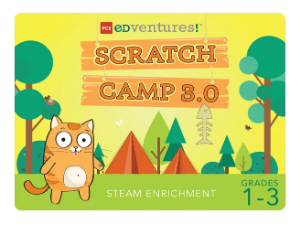
Renée: Welcome to the PCS Adventures Educator Spotlight Series. Today, we're exploring the world of coding with Mariam Ramahi, Youth Services Assistant at Chicago Ridge Public Library. Listen in as she shares how Scratch Camp turns every learner into a confident coder, bringing avatars to life, creating interactive stories, and building teamwork and creativity along the way.
Mariam: Hello, my name is Mariam Ramahi. I am a Youth Services Assistant at Chicago Ridge Public Library. I help out with youth programs. I plan some and facilitate some, like Scratch Camp and Podcasting. Everybody in Youth Services got involved. It was a group effort with that one.
Staci: When you used this, was this during a summer program?
Mariam: We started doing a coding program last year in December, and then we carried it in different sections all the way until June of this year. The Scratch coding was around February of this year.
Staci: Okay, take me back, before you started using Scratch, what were some of those challenges in planning some of those hands-on activities for these kiddos?
Mariam: The biggest challenge was really just trying to keep the same attendance because we were getting lucky with the number we had. So we had a solid 10 kids that would regularly come every week. We had it Mondays after school at four.
And so that was really just trying to keep them interested, trying to make sure that everything was easy enough for them to understand, but also still challenging enough to have them love to figure it out and everything like that. So that was the biggest challenge that we had. But luckily, because all of the programs and everything that we used in our grant was interesting, then the kids kept coming back.
Staci: That's awesome. So you were able to have some of the same kids over and over, which sometimes doesn't happen in a library setting. Sometimes you just get different kids every time, and then that makes it challenging. Some of our programs, all of them actually have the ability to just do one lesson at a time, which is nice.
So take me back to when you first opened this box with Scratch Camp, and what was your reaction when you saw the materials and the curriculum in there? And then how much time did it take you to get that first lesson up and running?
Mariam: When I first opened it, it was a little bit interesting because we did the scratch coding where the kids had to drag all the different commands, and they had to do a verb and then connect it with the little avatar that they had. So that one was a little bit confusing at first because it's a lot different from when I was in school learning the tech stuff.
So when I started playing around with it, because we tried to do that a few weeks in advance just so that we would know it off the top of our heads if the kids had any questions. So when I first opened it, I was a little bit confused, but then when I was following all the directions that they were giving, it was really easy and really simple to figure out.
Staci: Awesome. And what was the vibe in the room when the students were using it for the first time?
Mariam: So for the first time, they were kind of similar. They were a little bit confused because I think when you open the website, it's like a little like stimulating. So they're kind of like, okay, what's this over here? What's this over here? But then once they started getting all the instructions, and it was all connecting for them, then it was like the same thing. It was really easy for them to follow.
Staci: What were some of the most exciting parts? And what were they saying while they were working on some of the coding activities? And maybe some of those aha moments where something just clicked and they got really excited about something.
Mariam: So with that one, they really liked making their avatars do funny things like spinning or making them bigger, making them smaller. So once they started figuring out how to move it and how to match it with the background and stuff, then they were having a blast. And we let them work in partners a lot of the time. So then they would just have these little inside jokes with every group, and it would just be them laughing the entire time. So it was really funny to watch.
Staci: So they were able to collaborate and work in teams. And then how else did it help boost their confidence or their excitement with just learning something in the STEM world?
Mariam: So I think it boosted their confidence a lot because when a lot of them first started, they were all really shy. And this was actually the first time I've seen programs where it was a lot of groups of siblings. So we probably had, like, four pairs of siblings. But then because they were all kind of on the same boat with learning it, then they all were, like, talking to each other, interacting with each other, kind of switching up, like, oh, I'm going to be this person's partner instead of, like, my brother or my sister. So it made them all get out of their shell and really become friends with each other.
Staci: That's awesome. And compared to piecing the curriculum and all the pieces together that you would have to do to present and teach this type of a program, how much of a time saver was it to be able to just use some of the grant money and just order directly from PCS and get a kit that's just ready to go?
Mariam: Oh, it made things so much easier because with things like coding and any type of technology, sort of like class or program, you kind of don't know where to start. So I feel like these really laid out a great starting point for us. And once you start reading the instructions and just follow everything, then it makes everything so much easier.
Staci: Could you speak also to the durability of the materials? Is this something that you'll be able to reuse again with different groups in years to come?
Mariam: I think so. I think that the content was pretty timeless. And I think that it'll definitely be a good thing to keep for a while for a lot of these groups of kids that we see in the future.
Staci: So you mentioned it was a little bit tricky to get started. It has some challenges for you and then for the kiddos. But once you got going, did you adapt anything or did you follow the curriculum as presented in the book?
Mariam: So we kind of adapted it to them because there would be some weeks that we wouldn't get as many attendees as usual. So we tried to make it so that whenever kids would miss a week, they wouldn't miss too much. So there were some weeks where we just kind of didn't do a full-on lesson. We would just kind of have them play around with it because I think, too, people like my generation and younger generations kind of have to figure things out themselves. And I think that that's how they learn how to get all the commands and everything right.
Staci: Perfect. And then what lifelong skills will these kids take with them from this program? So if they look back, and remind me the ages that you had come in?
Mariam: We had 10 up to, I want to say, 13.
Staci: Okay. So a few years from now, you know, when they're even in high school and for some of them, what will you think they'll look back and remember or some of those skills that will stay with them that may transition into other technology classes in high school or college or even beyond that into a workplace?
Mariam: So one thing that I really saw with them was that they were looking at something like this in, like, not a black-and-white way. I feel like they were able to use a lot of their creativity and their self-expression while also still keeping on that STEM kind of path. And I like to say that they got to use both sides of their brain. They got to use the logic part and the fun part of it.
Staci: I love that. That's perfect. OK, anything else you want to add?
Mariam: No, Scratch was pretty straightforward. They loved playing with it, and they all got to make their own little story with it. So that was cute.
Renée: Thanks for tuning in. Mariam's story shows how Scratch Camp sparks confidence, collaboration, and hands-on STEM learning.
To see her students in action and discover more inspiring educator stories, visit edventures.com forward slash spotlight.