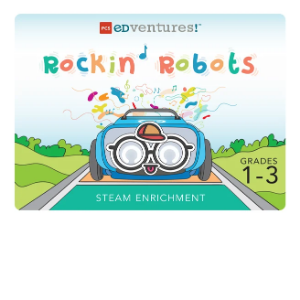
Renée. Welcome to the PCS Edventures Educator Spotlight series. Today, we're sharing insights from Dawn Green, after-school program director at Harwood Elementary. Listen in as she describes how Rockin' Robots turned curious K-5 learners into confident creators, coding, building, and even making music with their robots.
Dawn Green. My name is Dawn Green, I have worked for Harwood Elementary for nine years in different positions, but for the last five, I am the after-school program director. And so, I work with a group of kiddos after school, usually between one hundred and one hundred and twenty kids after school and through the summertime. So that's kind of my job.
Staci. That's a lot of kids to stay after school. How is that in comparison to how the population of the school as a whole, like how many stay after for these programs?
Dawn Green. We usually average between ninety and one hundred and twenty a night. And our school day is about one hundred or four hundred and twenty. So, we have about, almost a fourth of the kids stay after school.
Staci. Fantastic. That's great. Okay, so today we get to talk about Rockin' Robots, which I'm excited to hear more about first hand and how that went. Before you chose this program to implement, what were some of those challenges that you were having in creating some of these hands-on learning experiences?
Dawn Green. Well, because I'm not like a classroom teacher per se, and have a wide range, you know, we have kids from kindergarten to fifth grade. And so planning activities that interest those multiple grade levels and have all the pieces built in and with all the standards and stuff was a challenge. And so, I looked into the PCS programming because it just simplified all that for me. It was just all in one neat little package, which is very helpful when you're planning multiple activities for multiple grade levels.
Staci. And so what specific solution did this program provide? Can you walk me through when you first opened the box, you saw everything that was in there. And tell me your reaction to seeing the curriculum and all the products that were in that box.
Dawn Green. Very good. Okay. So when I first opened the box, I was excited to get the shipment. We used Rockin' Robots for our summer programming. And so, when I opened the box, I was really relieved to see neat little packages of everything from the smallest pencil to the, the Indy robot cars. It was a grab-and-go thing, and I didn't have to pull little pieces from this, and different places. It was all in one cute little package and it was easy and organized. Very easy to implement. Which is a huge blessing, especially for summer programming. Turnkey resources.
Staci. I love it. Talk to me about getting that first lesson up and running and how that went, and then some of those first aha moments and how you were enjoying the program as well.
Dawn Green. So the lesson plans are super easy to follow and to prepare. So each of the lessons has your list of supplies and the things you need to prepare as a teacher. And then it walks you step by step through the lesson plan on how to engage the kids and teach the kids, which I really appreciate because it takes a lot of the planning right out, but you're still providing a very good activity for the kids that are standards based and stuff. So we loved the lessons.
The kids loved building the instruments, the drums and learning about beats. They loved building the pan flutes and learning about high pitches and low pitches. And included is the little storybook. I don't remember the name, but there's a little story that goes with the program, that teaches high and low pitches. And, the kids really enjoyed that. It was fun to see them interact with the robots, and they're excited to use the robots. And then you teach them how to code on paper, and they're like, but I thought we were going to use robots, you know?
So the program builds up to using the robots. And so the excitement builds as, as you get closer to the actual robot day, which is fun. It was fun to see the kids gather as teams. I loved how the PCS program split the kids up in teams, and each team has different jobs. I have them written down like the track master and the conductor and the artist. And so every team member has a specific job, which I think really helps develop the teamwork between the kids. And then you switch jobs so everybody gets a chance to have a certain position, which I love to see the teamwork and the collaboration between the kids that really happens because of that teamwork.
Staci. Just building on what you were saying about the excitement and how, they had to start off doing stuff on paper and build up to the programming. And then what was it like when they actually got to see their robot making music and moving around on those little cards and what was that like?
Dawn Green. So when we did start using the robots, we started small and what I love about the Rockin' Robots program is baby steps. And so, the first time we just learned how to navigate, the app on the iPad and then when we started putting the blocks, the colored pads on the floor and, the kids are making the robots go certain ways, you can see their eyes light up. And they were like, totally engaged. And it was hard to get them to quit because they were having so much fun. And they were proud when they accomplished a goal. They were proud of themselves and wanted to show the team next to them, and they would call me over.
And sometimes it was a success. Sometimes they had problems they couldn't figure out. But it's the brainstorming that happened and watching their little minds just turn, "Well, if I did this, what will happen?" You know, thinking beyond the lesson of maybe if I make it go right and twirl in a circle, what will it sound like? Or, you know, building the songs with the pitches was impressive too. And they were proud of themselves. It was fun to see the excitement.
Staci. In this program is unique with the music element because a lot of programs that we have are STEM or STEAM. We have the art element, but this one's really unique with the music. In your experience with using different programs, how does the music element affect the kiddos with their excitement?
Dawn Green. I think the music just brings a different element to the whole program. It gives them one more piece of learning, "Oh, this pitch is high, this pitch is low. I need to stay on the beat." So teaching all those elements of a musical program, I think is so beneficial for kids to learn and grow. It just is kind of a missing piece that we don't always think about.
Staci. Okay. And so compared to piecing together a program like this on your own and trying to figure out the curriculum and then gathering all the supplies and how much time has a program like this saved you? And then could you also speak to the durability of this program? Is it something that you can use over and over for years to come, or what are your plans for implementing this again in the future?
Dawn Green. So we love the PCS program because all of the PCS programs, not just Rockin' Robots, because they are so durable, they're easy to use. They're turnkey. You can just pick up the program and read through the book and go through the supplies in the boxes, and you have the confidence and knowing that it's all right there, that you can do it. Preparation. You know, putting the supplies together. But other than that, it's all there for you. It is so wonderful.
Another thing that we really, really like and considered when looking at these programs was the reusability. I always make note in my notebook what year we taught rock and robots. So in two or three years, we'll repeat this program with the next group of kiddos. And so it really adds to our sustainability as a program to be able to use these programs over and over in a cycle. And the kids are just as excited the next time.
Staci. And earlier, you mentioned you're not a certified teacher, a lot of educators that we interact with aren't, some of them are librarians. And a lot of these programs get implemented in lots of different, learning environments. Can you just, speak to maybe somebody else out there in a situation like this where they run after school programs or or their librarian or they're not in a traditional classroom? The ease of implementing a program when you don't have a teaching certificate, how easy is it to walk through step by step and follow these without having that additional level of background or degree?
Dawn Green. Perfect. I am not a classroom teacher and do not have a teaching degree. So using these programs gives me the confidence as the facilitator of the program that I can teach. The standards are there and I am learning as I go, but I have the confidence of knowing that I'm teaching correct things, that the kids are gaining the skills they need as we go through these programs. I don't have to be the expert. I just have to be the facilitator of this program. And to me, that is priceless to have that confidence in knowing that if I follow this program, we're going to be fine.
Staci. I like the way you described that. The facilitator, I love it. And then have you found any other ways to adapt the curriculum or this program? Did you follow it as is, or were there ways that you kind of went off course with the way it was designed? And then the last question, will just be any lifelong skills that these kiddos will take with them from this program.
Dawn Green. We pretty much followed this program, as is as it was written. We did add a few STEM stories and books that we felt, were appropriate and fit the program. But, we really followed this program pretty closely. It's well written and it has all the points that you need to have a successful summer program.
Staci. And then just what are those lifelong skills from this program that these kiddos will take with them that, you know, years from now, they'll look back and be like, "Oh, I learned that when I did Rockin' Robots after school with Miss Green."
Dawn Green. I think that those skills, a lot of them, I hope that they take the team building skills that they learned, you know, working together as a group. Those to me are invaluable. And also, the skills of just fixing a problem when something doesn't work, we don't give up. We can fix it, and we can problem solve. A lot of the programs are great teamwork, problem solving programs. I hope that they remember all the science things and the coding. But those life building skills like the teamwork and the, "I'm going to figure this problem out whether it's hard, I'm not going to give up till it works."
Staci. Perfect. Okay. Anything else that you would like to add that I didn't ask?
Dawn Green. I can't think of anything. We love your programs. I recommend them to everybody who contacts me. About what, you know, if they're starting an after school program and need some advice, I always say, check out this company because they'll give you a good jump start.
Staci. Awesome. Thanks for the shout out.
Renée. Thank you for listening. Dawn's story shows how Rockin' Robots make STEM creative, hands on and exciting for every learner. To see her program in action and explore more inspiring educator stories, visit edventures.com/spotlight