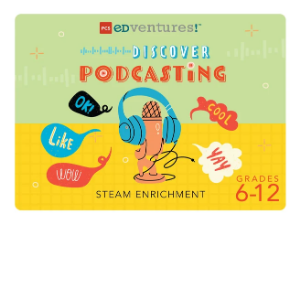
Carly Clark: Today we're speaking with Chris Welder about his work with Discover Podcasting. To start our conversation, can you tell us a little bit about your role and the organization you represent?
Chris Welder: I'm STEAM initiative coordinator for Somerset County Library. I help create and develop programming for the library, and also when we do outreach, which could be public schools and stuff. I also find interesting kits, like that you guys offer, to implement with lessons as well.
Carly Clark: Thank you so much. And can you provide us with a mental view of your learning space and the community of learners within it?
Chris Welder: Yes. We live in a rural area, so we always try to look for interesting, tech-related programming that we can do with the kids to kind of introduce them into computer science. We have families, some homeschooled, that come in for our programs. We also have public school learners that will come in during the summer because maybe their parents want them to keep mentally active during the summer and not sit on the couch or on their phones or something like that.
Carly Clark: All right. Thank you so much. And what drew you to this specific program, Discover Podcasting?
Chris Welder: Well, for here, I was dabbling into editing for some promotional stuff, and I really liked it and enjoyed it. Then I saw that you guys had a podcasting kit, and I thought that'd be really neat for the learners, the campers, to create their own show and then get to edit it and stuff like that, which is something I had an interest in. So, I thought if I was interested in it, maybe that would carry over, and the kids would also be interested in it, which actually turned out to be the case, which was great.
Carly Clark: Okay. And so we've all been there. A big delivery shows up, and your first thought is, "This looks amazing, but when am I actually supposed to find the time to prep it?" Can you take us back to that unboxing moment when you really got into the instructor guide and saw the roadmap laid out for you? What was going through your mind?
Chris Welder: So when I opened up the box, there were just so many different items to go through that were really interesting to check out, from the microphones to the pop screens. Then I got to the curriculum, and I was hoping that it would be laid out like Ready Set Drones. It was really nicely congruent—like it goes in order—and it just seems like it's easy to follow. So it was easy to digest. It just led from one lesson to the next, and it was easy to follow. Also, I could think of how I would want to lecture this to the kids in a lesson. So it was very well done, and I actually enjoyed just reading through the manual as well.
Carly Clark: Thank you. And if you were asked what a learner is gaining beyond what the STEM acronym stands for—science, technology, engineering, and math—what would you say?
Chris Welder: Oh, well, public speaking, which I think is an important skill to have to be able to stand amongst your peers and be able to speak. So that's big. That was a big thing with that. Also, being creative—you know, how to take an idea as a learner and be able to kind of flesh it out and turn it into an actual thing, like an actual show, in this case, a podcast show. I love lessons where they start with an idea and it actually turns into something physical, like a podcast.
Carly Clark: Yeah. The creativity piece is amazing. I feel like this is a great program for that. So to the educator listening who is hesitant to try one more thing because their plate is already full, why is Discover Podcasting the one thing that is actually worth the space?
Chris Welder: It's a big benefit to the kids because they work on writing skills. They work on, like I said, public speaking. They feel ownership of their show because it came from them, their idea, and to see them actually work on that and then work with a computer to do the editing and adding sound effects, learning that as well. It doesn't take a lot of setup to do, which is great. The program that comes with it does a lot of heavy lifting. Soundtrap helps with cleaning up the audio and making it a quality program as well.
Carly Clark: Soundtrap is amazing. I use it as well. I do love it. So there's a specific energy in the room when learners are deep in a hands-on STEM experience. Was there a moment where you saw a learner becoming more engaged or finding their spark with Discover Podcasting?
Chris Welder: Yes. I had one learner, and they decided to do a podcast—unlike any of the other ones, they wanted to do sort of a Twilight Zone kind of podcast. He really lit up with passion adding the sound effects and doors opening and closing. It was a very good quality show when he was done, and he went on from doing this program to actually now doing his own show. So that was really amazing. Yeah.
Carly Clark: Wow. Is there a name for this on Spotify?
Chris Welder: It's "Green" something. I don't remember the full name of it, but it's something like Green Lake Stories.
Carly Clark: That is so, so cool. And what age group was this learner in?
Chris Welder: He was about 15. This was mainly aimed at teens. We did have one who was 11, but we partnered her up with another child who was older that we thought worked well to help with the stuff she had trouble with.
Carly Clark: Very cool. So some of the older kids kind of guiding a younger learner—that's pretty cool as well. If you could go back to your very first day with Discover Podcasting, what is the one piece of advice you'd give yourself to get the most out of the experience?
Chris Welder: I would say, don't sweat the technical stuff so much. I was afraid the mics wouldn't work properly or the audio wouldn't come out right, but the microphone stuff is good quality. The programming has an AI cleanup tool on it. That's one thing I was worried about—background noise to where their podcast wouldn't be listenable and I would feel horrible about it—but the AI tools were able to clean it up to where it sounded well. So the technical part wasn't much of a hurdle to get over. It was actually pretty intuitive.
Carly Clark: Yeah. The intimidation factor with STEM can be a lot for an educator until you see the kids immersed and you go, "Wait, that really wasn't all that bad." Yeah, they're good at figuring it out as well.
Chris Welder: They were teaching me some things. They were teaching me some things, so.
Carly Clark: So to wrap things up, looking back at your time with Discover Podcasting, what is your single favorite memory or aha moment from the experience?
Chris Welder: Seeing how much the kids really got into creating their own shows. Throughout the curriculum and the lessons, they'll create multiple shows, and at the very end, they create their own big show. I was wondering how much they would be into it and stuff like that. Just watching them light up with enthusiasm—of, "Oh, I get to make a show! I'm into the Titanic, so I could do a show talking about the history of the Titanic"—and going through all the different sound effects and laughing because they found one that they thought was funny and how they would put it into the show. Just watching them like, "Hey, can you do this program again next year?" and seeing that, yes, this is a winner. It works. The kids love it. Getting their interest is something that I'm always trying to look for. What kind of programming would capture the interest of our learners?
Carly Clark: Well, that's the sign of an amazing educator—just so you know—making sure that you cater to their interests. So thank you for all that you do. Chris, thank you so much for sharing your story about your experience with Discover Podcasting and for the incredible work you are doing every day. It has been a pleasure having you share your experience with our STEM community. To our listeners, thank you for joining us. Are you ready to spark new breakthroughs for your learners? Visit edventures.com to find the perfect fit for your space. We'll see you at the next spotlight.
Chris Welder: Thank you for having me on.