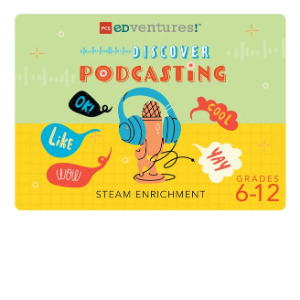
Intro: Today we’re stepping into the creative world of podcasting with Mariam Ramahi, Library Program Coordinator at Chicago Ridge Public Library. Listen in as she shares how the no stress curriculum turned a busy schedule into a masterclass on communication and confidence.
Mariam Ramahi: So my name is Miriam Ramahi. I am a youth services assistant at Chicago Ridge Public Library. And basically I help out with doing youth programs. I plan some and I like, facilitate some
Staci Mitzman: So circling back around to the top now, talking about Discover Podcasting. So walk me through how you used this program, and what the challenge was before you implemented this one into one of these after school camps or summer camps at your library.
Mariam Ramahi: So we did this one as the final part of our coding program. So this one was, just getting them started with topics and trying to show them podcasts because a lot of them haven't listened to podcasts. That was a little bit hard at first, but then they got the hang of it right away.
Staci Mitzman: Okay, so with this one, when you open up the box, you saw everything in there. Um, what was your reaction with, um, looking at the materials and the lesson plans and then how much prep did it take you to get that first lesson up and running and then walk me through how that went with the kids and the excitement and things like that.
Mariam Ramahi: So opening the box is pretty straightforward. You saw all the pieces, like the little microphone was pretty straightforward. The little acoustics to keep all the sound together. We struggled a little bit at first building it because when we were looking at the instructions and the pictures, we were trying to make sure that we weren't doing anything from the wrong angle. But once we built that first microphone, then we're like, okay, we got it. And then we were able to build a few more from there. We really just were trying to get ideas for topics for the kids so that whenever we would go into it, then they would have an idea of what kind of topics that they should be brainstorming.
Staci Mitzman: And what were some of the things that they came up with?
Mariam Ramahi: They wanted to do a lot of would you rather type of topics. So we had two groups. One of them ended up doing that, and then another one ended up doing dad jokes. So we came up with the idea altogether because they were stuck on the dad jokes. I was like well, it would be really funny if you guys just made a whole podcast of dad jokes without anything in between. You're talking and answering in dad jokes. So that's what they did.
Staci Mitzman: That is hysterical. That's so fun to hear what kids are into, what they want to talk about. But that's what makes this program so fun, is that they can just run with whatever interests them. So when they started to dive in, they found a topic that they were interested in. They started doing their own podcasting and recording, what were some of the things that they were saying or anything that clicked where they learn something new or they were just excited about something.
Mariam Ramahi: So with the dad jokes, they were actually coming up with some of those jokes on their own. They were trying to find out how to piece the jokes together and make it into a conversation. So that was the biggest challenge for them. But once we helped them figure out how to do that, then they would write it down in the workbooks and then just practice reading it so that it sounded natural whenever they were recording.
Staci Mitzman: That's cool, I love that. Um, so as far as confidence, um, what are some of the things that made them feel more confident using this type of a program? And what were some of those other skills that they had to develop. Did you have them in small groups to collaborate? Sounds like you did. Talk to me about some of those skills that will transfer into maybe other areas of their life.
Mariam Ramahi: So I think something that we did that built their confidence was we were pretty lean. But then also pretty strict with them in some points. We would let them play around with things and joke around. We also were trying to reel them in and be like, all right, so now you guys have played around with it. Now you really have to buckle down and get a topic. You have to sit down, write everything down that you're going to say and be serious when you're recording and try not to laugh at anything that you're saying.
Staci Mitzman: With piecing together something like this, if you were to just go out there, find what you would need to launch, you know, podcasting program and teach everything. What about the time that this has saved you to just purchase a program like this that's just all ready to go?
Mariam Ramahi: So I think this one is really good for anybody beyond school age kids who want to start a podcast. I feel like this is a really good way to introduce kids to a world like this.
Staci Mitzman: Did any of the kids talk about wanting to implement some of the things that they're doing in a podcast? And we started off just kind of fun. They're diving in and experiencing it for the first time. But did any of them say anything like, oh, I want to do this. Or did it spark any interest for future careers or anything like that?
Mariam Ramahi: I'm not sure about future careers for them, but I think that they all really liked the aspect of talking into a microphone. I feel like that kind of helped them for later when they all get to high school and they're going to have to start doing speeches, and they're going to have to start presenting things in front of people or when they get to college and things like that. I think it started turning those wheels in their heads about oh, this is not a laughing matter. This is something I'm going to have to take with me in the future.
Mariam Ramahi: Absolutely. Yeah. There's a lot of transferable skills from this one. So any ways that you adapted it or did you follow it pretty much as the curriculum laid out. Talk to me about any, any ways that you kind of change things up? So that one, we were pretty on it with the curriculum, just because it was such a simple one to follow. And we didn't have too much time with the podcasting because most of our students at that time were finishing up with school. So we were limited with how much time. So we really just followed the curriculum just so that we could get their podcasts running and completed.
Staci Mitzman: Perfect. So they got a good taste of it. That's great. And any other lifelong skills that they'll take from this. I mean, you mentioned public speaking and collaboration. Any of those that they would be able to use even in other classes or first jobs. Anything else you'd like to share of any of the skills that they would take away from a program like this one?
Mariam Ramahi: I think it made them more comfortable, because I feel like when you're in a small group like that. Sometimes if you go to community college and you're in a very specific type of class, you're going to only have a handful of people in your class. So I feel like it kind of opened their eyes to a classroom setting without many people. So I feel like that aspect of it really helped them learn.
Staci Mitzman: Okay. Anything else that I haven't asked that you'd like to add for any of these programs?
Mariam Ramahi: Definitely one of the most fun programs that we did.
Outro: Thank you for listening! Mariam’s story shows how Discover Podcasting’s simple to implement curriculum helped her learners dive right into their curiosity and creativity.
We’re always excited to hear about the creative ways our hands-on STEM curriculum is adapted to different learning environments.
To listen to more stories from real educators, visit edventures.com/spotlight.