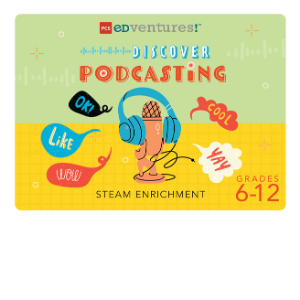
Intro: Welcome to PCS Edventures Educator Spotlight Series.In today’s podcast, we’re exploring how Katie Stimpson, Director of the Parma Learning Center in Idaho, broke down traditional grade-level barriers during her summer program. By adapting the Discover Podcasting curriculum to serve a group of first through eighth graders, Katie turned her learning space into a collaborative studio where there was no age limit to creativity.
Renée Lucchesi: Welcome to our interview. Can you first start off by telling me your name, where you work, and your position?
Katie Stimpson: My name is Katie Stimson, and I am the director of the Parma Learning Center. We're a Twenty-First Century after school program in Idaho.
Renée Lucchesi: Great. What was your biggest challenge with planning hands-on activities ?
Katie Stimpson: The biggest problem that we face is a common problem across the country. Especially with our middle schoolers – is just finding some activities that are engaging and keep their interest and keep them wanting to come back. And so we're just always looking for the middle school audience that we can serve in a different capacity.
Renée Lucchesi: Yeah, I taught middle school for a long time. I feel your pain. What were you hoping to find in a solution?
Katie Stimpson: I think the biggest thing is trying to find something that was – like I said, that would get their interest and want them to learn – to just explore things that they hadn't been exposed to.
Renée Lucchesi: And walk me back to the moment you first opened the box. What was your immediate reaction?
Katie Stimpson: I actually opened the box with my teacher educator that was going to be working with the content. And it was very overwhelming. There was a lot of product, and just trying to figure out where do all these parts and pieces go and what's it going to look like? Like I said, it was a great package but it was definitely overwhelming at first.
Renée Lucchesi: Uh huh. But you figured it out or your teacher figured it out?
Katie Stimpson: Yes.
Renée Lucchesi: Good. Compared to sourcing materials yourself, how significant were the time savings?
Katie Stimpson: It was awesome to just literally have everything that we needed in a box.
Renée Lucchesi: Yeah.
Katie Stimpson: That was huge. That was a huge advantage.
Renée Lucchesi: Great. And can you describe a specific time when a student had an aha moment?
Katie Stimpson: I think the biggest success celebration that we had with this curriculum was we actually used it during our summer school. So the intended purpose was for our middle school. And last spring the mindset of the kids was just, you know, just not in the right place. And so we said, well, let's try with the summer school. And we actually had students in grades first through eighth. And so originally it was like, oh, I don't know how these little kids are going to work with this? And honestly, some of our biggest success were with the first graders. And just like the – podcast that they recorded – and it was just so fun to see them totally light up and go home and they told their parents. And I had parents that were messaging asking how they could access the podcast that their first grader had produced. And so that was really a huge success.
Renée Lucchesi: Oh, great. How many kids were in the summer school program?
Katie Stimpson: We had about seventy five. Okay.
Renée Lucchesi: Great. Were there any peer teaching moments or collaborations in the classroom?
Katie Stimpson: So I would say there was actually quite a bit because we had first and second graders in a group, third and fourth graders in a group, and then middle school in a group. And so obviously there were some groups that were understanding a lot quicker. And so you would see the transition as they got things figured out and they were doing things. Then other groups were like, wait a minute, how are you doing this? And so we did have some peer teaching that did happen throughout the content. The week of summer school especially that we did it.
Renée Lucchesi: Great. Um. Speaking to other educators who might be hesitant, why should they give this PCs Stem program a try?
Katie Stimpson: I think just the biggest celebration is it's just absolutely incredible that everything is literally in the box. And so you can pick up the teacher's manual and everything is provided. I feel like PCS – they do a great job with their videos, their support, their online support. I just felt like there was a lot of flexibility within it. There was no real questions about the content. I feel like PCS does a great job laying out their curriculum and making sure that they provide every piece for it to make it successful.
Renée Lucchesi: Yeah.
Katie Stimpson: Grab and go.
Renée Lucchesi: Great. What advice would you give to colleagues new to using Stem programs?
Katie Stimpson: I would say the biggest thing is just don't overanalyze and jump in. It was just – it was very daunting at first. And then it was like, ohhhhh gosh, how am I going to do this and how is it going to work? And then it was just like, okay – like here we go. And realizing that with STEM – it doesn't have to be perfect. You don't have to have a perfect plan. Because that's what STEM is – there's so many different variables that come into it. And the kids make it their own, which is so incredible. And so I think that in hindsight, our curriculum set longer than I wished it would have once we got going. And it was really – like everything that they need or everything that you are going to need is right there at your hands. And it's just a matter of working through it. And the kids really – kind of talked about it earlier, but the peer to peer teaching. You know, the teacher didn't have to have all the answers because the kids helped figure it out on their own.
Renée Lucchesi: Mhm. Now that you've had so much success, I'd love to hear about creative ways you've adapted or extended the lessons. Sounds like you adapted them for multiple grade levels in summer school.
Katie Stimpson: Right. The biggest thing that we've done recently is we had them grouped in first and second, third and fourth in middle school. And one thing that we've done to kind of expand and put a creative twist on it, is to group our middle schools with the first and second. That has just been really fun to watch how the two age groups mold together. And in some cases, you would think that it was all peer teaching from the older down to the younger, but really when you're in it, you know, some of those younger students are actually the middle schooler – like, oh, I didn't think about that. So I think that's kind of been a fun adoption that we've made. And like I said, filling in the groups whether it was a younger or older. but just really mixing the middle school and the elementary together to see what they can create.
Renée Lucchesi: Yeah, that sounds unique and like a fun activity for the kids.
Katie Stimpson: And it really brings the kids out of their comfort zone.
Renée Lucchesi: Yeah.
Katie Stimpson: So often, the middle school kids have their cliques and their groups and it's just like, nope, not today. This is what you're doing. So kind of when you're forcing them out of their element and saying, nope, you're going to work with the first grader today. And they're like at first, you know, it's kind of resistant. Like what? And then it's like, this is really cool afterwards. So, it's getting them to realize that stepping outside the box can be okay.
Renée Lucchesi: Yeah. Like being a podcast buddy instead of a reading buddy or whatever is more traditional. Great. Is there anything else you'd like to add?
Katie Stimpson: All of my experience with PCS has just been very positive. And I think it's a great partnership that makes planning easy.
Renée Lucchesi: Great. Well thank you for your time and thanks for recording this interview with me.
Katie Stimpson: Okay. Thank you
Outro: Thank you for listening. Katie’s success with her learners highlights the incredible flexibility of hands-on STEM. By mixing middle schoolers with elementary students, she fostered a unique environment of peer-to-peer teaching where students of all ages could find their voice and learn from one another. We’re always excited to hear about the creative ways our hands-on STEM curriculum is adapted to different learning environments. To listen to more stories from real educators visit edventures.com/spotlight.