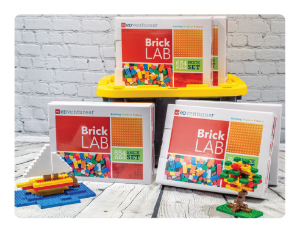
Intro: Welcome to the PCS Edventures Educator Spotlight Series. In today's podcast, we meet Kelly Parker — a fourth grade teacher in Suwannee County, Florida, whose search for the perfect hands-on manipulatives led her to BrickLAB Bricks. The result? A classroom full of highly engaged, happy learners who are building, collaborating and solving problems without even realizing how much they're growing.
Carly Clark: Today we're speaking with Kelly Parker about her work with our BrickLAB products. She won a PCS contest a few years back and earned many BrickLAB bricks to use in her classroom. To start our conversation, can you tell us a little bit about your role and the organization you represent?
Kelly Parker: I'm a fourth grade teacher in Suwannee County, Florida. This is my twenty fourth year teaching in primary school. In my fourth grade classroom, I bring the Florida best standards to life by using the Bricks as they are highly engaging hands-on. What I used them for recently was teaching area and perimeter. The lesson directly supports the Florida standard, the benchmark, where students solve mathematical real world problems involving rectangles, area, perimeter and the relationship between the two. The Bricks bring highly engaging motivation. Students work collaboratively to build the rectangular models using the bricks. It's concrete. It allows them to use their hands, and see and touch and manipulate to make the structure for the area and perimeter. It creates conversation, problem solving, higher order thinking. The students don't even realize that they're learning math. They're so engaged and happy about learning. It's been a successful lesson using the Bricks for area and perimeter. I've also used the Bricks for different lessons in every classroom. Every learner is different, and I have high groups, low groups, medium groups. I've even used them for addition, subtraction, sorting colors and reading. You can put letters on them. There's just a variety of lessons you can use the Bricks with.
Carly Clark: Well, thank you for sharing that. And can you provide us with a mental view of your learning space and the community of learners within it?
Kelly Parker: Our learning space in my classroom — I'm a very hands-on teacher. I have flexible seating. We are on the floor. We're building on the floor. We're building in groups in the classroom. It's not really traditional when you come in my room, I would say it's not chaos, but it looks like chaos when you come in. They're highly engaged when they're moving around — they're working together. In my classroom, there's high energy.
Carly Clark: I love that. I want to be in your classroom and hang out and watch everybody learning. So, what drew you to that contest? Why did you apply?
Kelly Parker: Well, as I said, I'm a hands-on learner, and that's how I teach. So I'm always looking for ways to bring supplies into my classroom, because you know, the district — they only give you what they can give you. And I'm constantly seeking new materials for hands-on, like I said, flexible seating. I'm always looking for that, and hands-on manipulatives. And I saw the Bricks, and I was like, I really need to bring that into my classroom, because my mind was just going on how many things we could do with that. And it was fortunate enough that I won. And I have been using them for five years now, from grades — I've taught grades K through four, and it's helped a lot of children.
Carly Clark: That's great to hear. Well, thank you for applying, and we're appreciative that you are so appreciative. So, as educators, we've all been there. You get a big delivery, and it shows up, and your first thought is, "This looks amazing, but what am I actually supposed to find the time to prep?" Can you take us back to that moment when you were unboxing all of the materials, and then you kind of got into the instructor guide and you saw the roadmap laid out for you? What was going through your mind during that unboxing?
Kelly Parker: Well, at first, when I saw the amount of materials, I was so excited, and my mind was racing, like, okay, what are we going to do? And then, unpacking it, I had to figure out where I'm going to store this. And because I do have a lot of things in my classroom, I just went through my standards and my lessons and researched things that I can do with them. And, like I said, I'm hands-on, and I just went to the standards and applied the lessons together and created activities for them to do.
Carly Clark: That's wonderful. Well, thank you. If you were asked what a learner is gaining beyond what the STEM acronym stands for — Science, Technology, Engineering and Math — what would you say? So, transferable skills.
Kelly Parker: Like I said, higher order thinking, conversation with each other, real world application and also play. We don't get to play anymore. Like I said, I taught K, one and two, and that's going away, and we need to bring that back. We need to find ways to bring play back into the classroom for students to have conversations, to solve problems. And working together creates that.
Carly Clark: I couldn't agree with you more. So thank you for sharing that with me. So, to the educator listening who is hesitant to try one more thing because their plate is already full — why is BrickLAB the one thing that is actually worth the space?
Kelly Parker: Students are already familiar with Legos, and they love Legos — all students. Like I said, I'm teaching fourth grade, and I brought the Bricks out, and they were so excited. So they're familiar with it. It's not that much space to store them, and it does get messy. Some teachers are very controlling, and they have to have everything perfect. I would say just give it a try, let it go — you're going to see such a difference with your children. They're going to be highly engaged, happy learners. Take the plunge.
Carly Clark: Awesome. Thank you. And you kind of mentioned this just talking about your space. There is a specific energy in the room when learners are deep in a hands-on STEM experience. Was there a moment where you saw a specific learner becoming more engaged or finding their spark with BrickLAB?
Kelly Parker: Yes, I have a student with autism in my class. And, you know, you have to find things that are on their level and things that help them, because they're different learners. And the Bricks — he just saw the other students with them and started to play with them and build things and learn. And he was so engaged and so happy. And he's mute but talks sometimes. And he just started talking up a storm — like I'd never heard him talk so much before. So these Bricks help all types of learners, all types of children in your classroom. And sometimes he just walks around the room, and this time he was engaged. He was learning — he was learning from the other students. And it was just great to see.
Carly Clark: That's an incredible story. Very cool to hear. And if you could go back to your very first day with your BrickLAB materials, what is one piece of advice you'd give yourself to get the most out of the experience?
Kelly Parker: The advice that I would give myself is to plan. I kind of want to open it and jump right in and give it to the students, which is fine — you can let them. When I introduce a manipulative first, I always let them play, and then I go over the rules at the beginning of the year, and then we start the lessons. But yeah, I just wanted to dive right in and open them up. And I did. I gave them to the students and let them share the excitement. I said, "Look, we won this!" And I opened it with them together and got them out, and they helped me organize them and sort them. So, one thing I would say to myself, looking back — I really just jumped into it. I didn't even think about anything. I just brought it into the classroom and opened it, and had the students open it with me, and enjoyed the excitement.
Carly Clark: I'm sure your students really appreciated that you went that route.
Kelly Parker: It's like, okay, let's stop for a minute. Look what we got. Look what we got for our classroom. So it was an exciting moment.
Carly Clark: Probably like Christmas morning to some of them.
Kelly Parker: Yes, it was. It was great.
Carly Clark: Well, to wrap things up — when looking back at your time using your BrickLAB materials, what is your single favorite memory or "aha" moment from the experience? So, if you could give us a consensus of just your favorite memory you've had.
Kelly Parker: I think I will say my favorite memory I have is when I got them, and opening and sharing in the students' excitement. And the excitement — you know, telling them, "Okay, we're going to use this for math, and we're going to use this in science." And just the excitement, and the look on their face. One of my students said, "Oh, I love learning like this. This is what I love — learning, rather than sitting there with the book open." He was a hands-on learner, and it just brought excitement to him and wanting to learn. So, to me, with a student saying, "Oh, this is how I learned — this is what I really like" — it means that we need to bring that into the classroom.
Carly Clark: Well, Kelly, thank you so much for sharing your journey using your BrickLAB products. The work you're doing for your learners is incredible, and we are so grateful to have your voice and insights as part of our STEM community. Thank you.
Kelly Parker: You're welcome. Well, thank you very much for changing the lives of my students.
Outro: Thank you for listening! Kelly needed hands-on materials that could spark real engagement in her classroom — and BrickLAB Bricks delivered. Her learners are having conversations, developing problem solving skills and higher order thinking, all while loving every minute of it. That's the power of hands-on STEM. To see her program in action and explore more inspiring educator stories, visit edventures.com/spotlight.