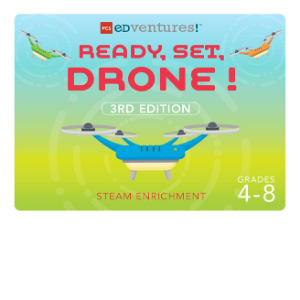
Intro: Welcome to PCS Edventures Educator Spotlight Series.In today’s podcast, we’re highlighting the incredible work of Chris Welder, who is the STEAM Initiative Coordinator at Somerset County Library in Pennsylvania. Chris brought Ready, Set Drone! to his rural community and watched a hesitant learner become one of the best pilots in the room. He found that sometimes, the right curriculum is all a learner needs to grow their self-esteem.
Carly Clark: To start our conversation, can you tell us a little bit about your role and the organization you represent?
Chris Welder: Yes. I'm the Steam Initiative coordinator for the Somerset County Library. I help develop and pick out different curriculum to have programming for the children in our area. Sometimes with adults too, but I mainly focus on adolescents.
Carly Clark: Nice. Well thank you for sharing that. And can you provide us with a bit of a mental view for all of the listeners of your learning space and the community of learners within it?
Chris Welder: Yeah. So basically we're in a rural area, so we like to come up with computer science related programs — maybe tech related programs for the public. And typically there could be kids that are homeschooled and like our summertime camps are our biggest programs that we do. And a lot of times we get homeschoolers that come in and their parents want them to socialize and learn something that maybe isn't in their curriculum that they learned throughout the school year. We also do get kids from public school that their parents want to, you know, keep their minds going throughout the summer and not just sit on the couch and watch TV or be on the phones or what have you. So we get a diverse range of people that do come in for our programs.
Carly Clark: That's awesome. So it sounds like, yeah, you serve quite a few different populations. That's really cool. So what drew you to the ready set drone program?
Chris Welder: Well, I wanted to do drones maybe a year before I saw you guys program. And we live in a very windy area and it didn't seem like it was feasible. And I was looking at different ways that it could be done. And then I stumbled upon your website and I saw that you had a kit and that within the kit was drones that could be outside, but also they could be inside drones. And I thought that was great that they were small enough. And I looked over the sample curriculum and I just absolutely loved it. And I thought, let's give it a try. That's kind of what got me interested in bringing it to our programming.
Carly Clark: I love that. Well, thank you for getting your learners involved in something new. Was it a bit of a learning curve for you at all, or was it pretty simple to get started?
Chris Welder: Well, I was really impressed with how the curriculum was kind of laid out. It was easy to follow. The flying the actual drone part — that's something, you know, there's no booklet that's going to properly prepare you. That's something you got to get your hands on and actually practice with. But the course actually was laid out very nicely. And I felt like, yeah, this is doable, this is manageable. And then when we actually started implementing with the kids, they absolutely loved it. It's like one of our most popular programs we do in fact.
Carly Clark: That's really good to hear that it was pretty easy for you to implement. That's obviously what we want to hear too. That it works for you. So we've all kind of been there as educators. A big delivery shows up of supplies and your first thought is this looks amazing, but when am I actually supposed to find the time to prep it? Can you kind of take us back to that moment when you were unboxing this program, and you got to see the instructor guide, and you saw the roadmap laid out. What was kind of going through your mind at first?
Chris Welder: Oh, well, if I be honest, it was sort of like Christmas a little bit. So when I opened it up there's tubs and there's other tubs and I'm like, what is this? What is this? Oh, this is neat. How does this work in the curriculum? And there were so many different cool items through it. And then you’ve got to stop — saying, let me put this aside, let me read the book. Okay, so you start going through the book and then it takes you from A to Z. It walks you through this part, then you go into this next section — like flight safety. Like the one part I liked about the curriculum was it focused on taking off and landing. And I thought that was a very important part for the kids. Doing stuff in the air is great, but most important is being able to take off and land safely and not crash the drone. So, just dedicating a whole day to working on our taking off and landing skills and also safety. I love that safety was a big part of that too. And I stressed highly with the kids that safety is the most important thing. In fact, they're not allowed to take off unless the safety officer gives the thumbs up that it's safe to do.
Carly Clark: That's super cool. So if you were asked what a learner is gaining beyond the acronym for STEM — Science, Technology, Engineering and math, what would you say?
Chris Welder: I'm sorry, did you say what they would learn beyond that?
Carly Clark: Yeah. What other transferable skills?
Chris Welder: Well, leadership skills. Because they will change roles. Like we just talked about the safety officer. They have to be able to say hey, look, no you're not being safe, you can't take off yet. We have to do this first. Checking the batteries, make sure the batteries are not scratched or there's no possible chance of them malfunctioning or something like that. Communication skills because the safety officer will also act as a spotter while the pilot flies. So they have to communicate with each other because the spotter will be looking at the area around where the drone is at, and the pilot will be looking at the screen. So the safety officer who's also the spotter has to say, hey, look, you may not notice this on your screen, but you're getting too close to that wall or you're getting too close to another student.
Carly Clark: Those are great transferable skills they'll have to take with them far beyond working with you on drones. Yeah. So to the educator listening who is hesitant to try one more thing because their plate is already full. We're very used to that, right? Why is Ready, Set Drone! the one thing that is worth the space.
Chris Welder: Well I work with a lot of kits from different companies and I feel the Ready, Set Drone! curriculum is laid out in such a way that it's intuitive. And that's what I look out for a lot is something that's intuitive that you can say, oh that makes sense, I understand this. And there isn't like a ton of research that you have to do because a lot of that information is contained within the curriculum itself. So there's not a lot of homework that you might have to do with it. And the benefit that it gives the kids. Like watching their faces light up and be excited for that. Every time they come in, the first thing — "Are we going to get to fly today? Are we going to fly today?" It makes it worth it. It makes it worth it. And there's not a whole lot of set up. There are hoops with it. You can have an obstacle course to fly through. That's probably like the biggest setup thing. And you don't really have to do that if you don't want to. I choose to because the kids absolutely love it and I'm willing to go the extra mile for that.
Carly Clark: You sound amazing. I would want to be in your group doing what you're doing getting those extras, which I think are so important. So there is a specific energy in the room when learners are deep in a hands-on STEM experience. Was there a moment where you saw a learner becoming more engaged or finding their spark with Ready, Set, Drone!?
Chris Welder: Yes. I had one girl and she was absolutely terrified of the drones. And I was trying to coach her, trying to get her to believe in herself. And she just was terrified. And the good part was she had her sister with her. So her sister was saying, you can do this, you can do this. And she got hands on time with the drone. And from the beginning of the week she just got better and better. And then from the very end, she was totally comfortable with it. This is nothing. I can definitely do this. She got her self-esteem which I really liked that she built up self-esteem to where she actually attempted the obstacle course and did the races with us. And actually, her flying skills became one of the best in the group. And just watching her go from being timid about it to finding this courage. It was inspiring.
Carly Clark: That is an incredible story. And obviously that's what every educator wants, right? Is to have those kids that are a little bit nervous come out of their shell. And I think that's why STEM is so important. So if you could go back to your very first day with Ready, Set, Drone! what is the one piece of advice you'd give yourself to get the most out of the experience?
Chris Welder: I was a little bit nervous myself having these kids operate these drones. And really, once you kind of walk through how to be safe with them and the techniques of how to properly fly and stuff like that — they take it serious. They get invested in it. And you can trust the kids to a certain extent to be safe operators with the drones. And I felt my nerves left because I just felt like they were going to fly them into the walls all the time and maybe bump into a kid or something like that. And that didn't really happen. And I wish my first time that I was a little more trusting with them in their experience with learning to fly the drones. Because by the end of the week, I was confident in the kids because they took it seriously and they became very good fliers.
Carly Clark: That's awesome. And so this is to wrap things up. Now, looking back at your time with Ready, Set, Drone! what is your single favorite memory or aha moment from the experience?
Chris Welder: Oh, my single favorite memory. My favorite memory is probably when we do the obstacle course, and the kids will race through it. And I'm just looking at them like, this works this, this works. I'm thinking over the week and how everything that they learn kind of led to this obstacle course where they have to practice all the skills that they learn. And to hear them say, “I want to get a drone. Maybe I want to look into a career as a drone pilot.” I was like, you know, this is something we're going to do again and again, I think. We have ran Ready, Set Drone! three times here. I've actually gone out to other schools and ran it. It’s one that just works really well with the kids.
Carly Clark: Well, thank you so much. So Chris, I really appreciate you sharing your story about your experience with Ready, Set Drone! and for the incredible work you are doing every day. It has been a pleasure having you share your STEM experience with our community. And to our listeners, thank you for joining us. Are you ready to spark new breakthroughs for your learners? Visit adventures dot com to find the perfect fit for your space. We'll see you at the next spotlight.
Outro: Thank you for listening! Chris needed a curriculum that was simple to adopt and exciting for his learners. The result? Breakthrough moments and unmatched engagement. That's the power of hands-on STEM. To see his program in action and explore more inspiring educator stories, visit edventures.com/spotlight.