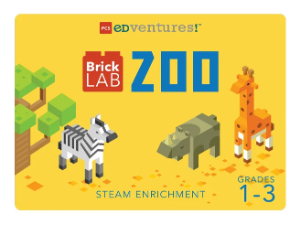
Introduction: Welcome to the PCS Edventures Educator Spotlight Series. In today’s feature story, we’re exploring how Sherry Scheline, director of the Donnelly Public Library in rural Idaho, is bridging the gap in STEM access. By bringing BrickLAB Zoo to her community, Sherry is proving that with the right tools, any child can build confidence, curiosity, and critical thinking skills.
Sherry Scheline: All right. My name is Sherry Scheline. And I am the director at the Donnelly Public Library District in Donnelly, Idaho. And I have served here as the library director since two thousand and eighteen, when we opened our doors as a public library.
Staci Mitzman: Excellent. Before you started using this program, what were some of those challenges that you were facing in creating some hands-on activities for some of your patrons?
Sherry Scheline: I think the biggest challenge that we will always face living in a resort community is lack of staffing. We are constantly revolving in our staffing situation. So housing is super expensive where we live. We have to compete with different other temporary, seasonal, recreational jobs that oftentimes pay more. And so our staffing situation is constantly revolving as well as constantly weak. And our staff often lacks training. Our staff often lacks consistency, and also longevity. And those things are no fault of the library. It is just a fault of where we live, conditionally. We're in a resort community. We're in a recreational haven where housing is super expensive. And we can't pay wonderful educators enough to be able to live here. They just can't afford it. And so we're constantly just finding who we can to fulfill the role we need for right now. And so, our biggest hurdle is just finding trained staff. And then once we find that trained staff finding their availability for enough hours to do lesson planning. Do executive management of a program. And then obviously the implementation. So usually what we can find is just those implementation hours. So we can find a parent who can come in from work from three to six and run our after school program, but they don't have any prep time. They don't have any executive management time. They're here from three to six, and they're going to run the program from three to six. And so we really needed something that was hand over turnkey ready.
Staci Mitzman: That's exactly what I was going to ask next is specifically, how did BrickLAB Zoo help you overcome this challenge? And talk to me a little bit about that. When you first opened up the box, saw everything that was in there. Talk to me about how it helped ease your preparation and start jumping into these lessons.
Sherry Scheline: So BrickLAB Zoo comes with everything all ready to go. And a teacher manual includes all the educational standards it's meeting, it outlines it. So if you have to code anything for grant purposes or financial purposes, it's already there. We luckily were able to purchase it with some grants that were from the ARP and ESSER Funds through the Idaho Stem Action Center. And so our monies, we didn't have to code anything or prove that we had done anything specific as far as the education there. We just needed to show that we had used it for one summer and we have obviously continued to use it. We have implemented the BrickLab zoo five times in our own programming, plus it's been checked out and circulated. We just needed something that was just ready to go. Living in a small rural community we also don't have resources to go out and shop for little things. When you're doing a lesson plan –if it requires extra scissors or if it requires simple things like straws. Straws are one of these weird things you can't get anywhere. There's no store that has straws. And so you have to go to a restaurant and ask for straws, or we have to go to Sink or Station and beg for straws. Can I have twenty five straws? I’ve got twenty five kids. So it's little things like that. And the nice thing about all of the PCS Edventures kits – not just BrickLAB Zoo, but all of them, is they come with enough products for thirty kids is what we purchased ours for. So all of our kits come with enough product for thirty kids. And then we have time to replenish it after the fact. If we're going to run it a second time, we have time to order, you know, like aluminum foil or things that it requires. So that was the nice thing about the kit when it came in – is that I was reassured that no matter where we did the kit – whether we were doing it here at the library or at the school or at one of our local businesses, or even using the community center at the fire station – we had the kit. Everything was in it that we needed. All I needed to bring was that kit, and I didn't need to run around the library for twenty minutes trying to grab different things. So that was the nice thing for me when we got it.
Staci Mitzman: Can you walk me back to maybe a couple different moments when you introduced this to some kids and some of those – the aha moments or what was the vibe in the room or what were some of those things that they were most excited about?
Sherry Scheline: I think when we got them the kids were just so excited that we finally had Legos. So Donnelly is, for a lack of a better description, kind of like the redheaded stepchild of McCall. McCall Public Library has a Lego program. They were at the time running it on Tuesdays, and they had Legos, and we did not have Legos. And when I say we did not have Legos, we had Legos. We had our leftover family Legos that we had donated and somebody else had donated a few. And so we had this Modge podge collection of, you know, maybe five hundred Legos. And so I think that that was the thing in comparison to McCall, we never get the cool things. McCall always has the cool things. So for our kids, it was super cool because we didn't just get Legos. They were brand new in a box, they're brand new Legos. And for our kids it was this huge thing that they were getting to open brand new Legos. And I know that that does not have as much to do with the kid itself as just the wonder of this grant for us, because our kids do tend to be from lower socioeconomic families. They tend to be from families that financially can't afford Legos, even at home. And they were so excited that they were getting brand new Legos. And this kit came with so many Legos that it was like, oooooh. And, and so I think that was the biggest thing for these kids is that the moment that they open these bricks, they were more than just bricks for these kids. They were more than just building bricks. They were this way of making them feel that they had something as well as their neighbors. So, it made them feel equal in a very needed way for them at the time. And I think that that was a wonderful thing when we opened the kit the first time. And we've implemented the kit in different ways. I think that each time that we do it, the wonder of throwing the Legos out or putting them out on the floor, or when we bring them all out at once – is still awe inspiring to every single one of these kids. Because they love to brag that we have more Legos than anyone else in Valley County. I know that that seems like a silly brag and it seems like a silly status thing. Oh, we have more Lego bricks than anyone else. But for the kids it is something, and they love coming back into our STEM room and showing people our Legos on the wall. I mean they stack so high and they love showing people how many that we have. I think that that's important for our kids because our kids do have so many deficiencies over other children in our county, socioeconomically. So our kids just can't afford it. So I think for them that was the big deal is that we got – we got Legos.
Staci Mitzman: That is a big deal. And then when they've actually worked on some of the lessons or some of the builds with these zoo animals, what were the things that they were most excited to learn about as they were building? And then what are some of those things that you think kind of built their confidence as they were learning while having fun.
Sherry Scheline: So BrickLAB Zoo - we learn about animals and habitats and not just animals from our local community but animals all over the world. They learn so much in the lessons themselves that took them far beyond the artistry of the Legos and far beyond the engineering of Legos. It was much more than that. It was also the critical thinking skills that they were able to achieve during that process. Monkeys was a fun one to build. And conversations about how the alligators they built the day before were so much smaller or how much bigger the monkey is. Why is the monkey so big? We need littler Legos for the monkey. And all of these really great conversations that happened with the lessons. Like, why don't they make the monkey on a smaller figure? If they removed the two center pieces and trying to figure out even ways that they could build it smaller. And rewrite the lesson description to make it smaller or how they could turn the monkey lesson into a gorilla lesson. It was things like that that I really enjoyed each time – was them learning critical thinking skills around the actual lesson, and also their respect for each other in building it. We have all ages. So we have K through fifth grade, and then we have middle school and high school helpers. So a lot of BrickLAB Zoo is for slightly older kids than K through second and our K through second have to participate in it. And so we do a group project. So it's K through fifth grade. And so they're all doing the same thing. I mean, you got to think a whole elementary school, all of those ages, those fifth graders are in a whole different place than those kindergartners. So the nice thing for us is it is written for that middle grade – that second to fourth grader really. Our K through seconds and our fourth and fifth do pretty well with it. Even though it's harder for the kindergartners with their fine motor to put the pieces together. It was nice for us to have the fifth graders be able to partner with the kindergartener. So we would partner those outside edges if you will to make it more well rounded. And so our fifth graders would partner with our kindergartners to kind of do that component. But I loved those portions. The lesson plans – I love that it goes outside of just what you're building. We were just building the animal with the bricks. But we're learning about their habitats. We're learning about where they're from. We're learning important facts. And then of course because we're a library, we choose a book each day to go with our lesson. That was really nice too, because even though that was a little additional lesson planning component, it's super easy for us because we could just find it. We could just put in our system whatever animal it was and then pull the book. And so everything we did that particular day would be surrounded by that particular lesson plan. So if it was the monkey or the alligator, then the book would be about that. The science lesson would be about that. So everything would be geared towards that. It just makes lesson planning so easy and takes the thought process out for whoever the instructor is and makes it go so smooth.
Staci Mitzman: That's great. And then I was just going to ask you if you found any other ways to adapt it. Is there anything you'd like to share? I know you've taken it into different schools. You even took it to the local bar. If you want to share any bit about that. And then just what are some of those lifelong skills that the kids will take away from this specific program? What are some of those things that they will remember forever based on this activity?
Sherry Scheline: So, I think one of the things that they'll remember forever is this summer our theme for summer reading was Color Our World – which is the National Summer Learning Program. Instead of doing just different colors we did around the world this year, and when we were at different continents, we were discussing different things. When we would discuss animals in different continents, a lot of these kids knew about those animals through BrickLAB Zoo. They would tell you things that they had learned last summer through BrickLAB Zoo. And so I think some of that rote knowledge comes from this activity that they're doing and these lessons. So it was nice to see that they held that over and how the learning had withstood the year. Because it is enjoyable learning. When they like it their retention's stronger. So, I loved that. As far as where we've adapted it. So, the school does a STEM night and three of the teachers put it together and they have STEM in different classrooms. So we offered to participate and do Lego night at the school. The school's mascot’s a dragon. And so they had to build a dragon. And so we created our own additional lesson that is a dragon in the BrickLAB Zoo. And then in our after school program – another way we adapted it is at the end. So once we finished all of the zoo animals in BrickLAB Zoo, we finalized it by reading the Doctor Seuss book If I Ran a Zoo. And then the kids were able to build their own animals on the last day. So if we read If I Ran a Zoo and they got to put two animals in the zoo, one is an animal that they created out of their own imagination. And then the other one is they had to create one of the animals that's in the book If I Ran a Zoo. So we adapted that here at the library when we finished BrickLAB Zoo, and then we did it at the school once. And then the other thing that we did was a community outreach, which is kind of our little fundraiser to help fund our after school program. At the bar in town called The Roost, we did a family night and people paid five dollars. And when they paid their five dollars they came in they got a box of Legos. They could work as a family or as an individual. Or you could work as a team. Sometimes people would take their whole neighborhood and come together. We talked about BrickLAB Zoo. We showed the lesson, and then how we use it. And then their theme that night was Traveling Architect. They had to do place and home, so it was Adventure in Idaho. So they needed to do Idaho animals, Idaho place, something that represents home for you. So we got forests and it was also Smokey the Bear's birthday, so we had a lot of Smokey the Bear. This was last summer. And then they pay five dollars and then the winner at the end of the night gets fifty percent of the earnings. And they walked home with I think two hundred and fifty dollars. And then the library got two hundred and fifty – which isn't a lot of money, but it's enough to kind of like offset some things. So we've implemented those places. We've also taken it to a local church camp that wanted to use it. And then we've checked it out a few times. Our community school has used it. So we have the McCall Community Charter School. One of their teachers checked it out, and she used the curriculum up at the at the school, in the actual classroom. So it's been used at several different spots. It's not a one use thing. BrickLAB Zoo is one that is never going to run out. the bricks are going to last forever. So, you can use it over and over and over again. You can even use it with the same children, too. I just implement it slightly different. We always choose a book, like I said, that goes with it. So choose a different book. They love rebuilding these things and they'll build it different the next time. So we always choose a winner. We're all about winners. We do not do participation trophies here. We're all about winners. We have a very competitive group and that probably stems from the fact that I'm very competitive. So they get brag tags and they get a brag tag if they win, if their animal is the best. But they also get a brag tag if they follow the directions the best. So if they follow the BrickLAB Zoodirections the best, they can also win a prize. But we also don't want to ding them for their creativity, so we allow them to get the best skits. And so in BrickLAB Zoo, we give a creativity prize if they change it up a little bit. But you can also add that as a component, like, okay last time you did this, you just made the alligator. How can we make the alligator different this time? Do we make the tail longer? Do we make the snout longer? So I think that you can continue to reuse it over and over again. So the value is there. If you're looking for a value and you're like, why am I spending X amount of dollars to use a kit one time? You're not. You're spending X amount of dollars to have a lesson that's going to last forever and ever and ever. And especially if you're a library, you can circulate it. Circulate it to teachers. Libraries should be servicing our community as a whole. And so I do think libraries need to make the investment and then organizations can check it out.
Outro: Thank you for listening. Sherry’s story is a powerful reminder of how equitable access to learning can spark joy and curiosity in every child.