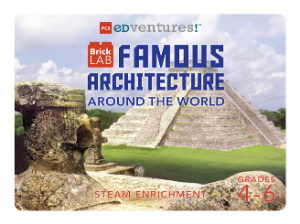
Intro Welcome to PCS Edventures Educator Spotlight Series. In today’s podcast, we’re speaking with Sherry Scheline, Director of the Donnelly Public Library. She faced a challenge familiar to many – an unfortunate staffing situation that required a program to be an "easy grab-and-go" solution. In this episode, we explore how Sherry implemented BrickLab Famous Architecture to turn simple building activities into hands-on technical discoveries. We’ll discuss how this turnkey curriculum helps learners turn today's curiosity into tomorrow's professional skills.
Staci Mitzman First question, what was the biggest challenge before you started implementing this program?
Sherry Scheline Biggest challenge before implementing this was the same as the other one. It's just our staffing situation is so unfortunate in Valley County. And so we just needed something that is an easy grab and go. And that is right out of the bag. And this one I can tell you is great because it's done in such a way that even if you didn't pre-read it, you are able to successfully, without breaking a beat, teach the lesson. So even if you have not pre-read it, no matter if you're really intelligent or if you were just basic knowledge – a high schooler could teach this lesson plan. So that's what we love about it – is that we can have any of our volunteers teach it, any of our high schoolers teach it, any of our long term staff teach it. It can all work the same.
Staci Mitzman Okay. And take me back to when you first opened this box and saw all the things that were in there with the program, the curriculum, and then all the bricks. And then how much prep time did it take you to get this one up and running?
Sherry Scheline So Famous Architects around the world – we actually got a curtailed kit. So we won this kit for taking a training for the Idaho Commission for Libraries. And so it was only a partial kit. Eventually we're going to order the full kit. The reason that we're going to order the full kit eventually is because we liked it so much. The only things that we're missing though were some additional bricks. And so we had those from BrickLab Zoo. And so we combined the bricks themselves from BrickLab Zoo with the Famous Architect to have enough bricks. But we had all of the student guides as well as the teacher guides. So from our smaller kit….and when we opened it – I think the biggest excitement for me was the ability for the children to see how they could build actual architectural structures: like the Eiffel Tower, like the Empire State Building. And then when they would complete them, how excited they were that it actually looked like those buildings. Like they would get so excited. Like this really does look like the Taj Mahal. This really does look like a pyramid. And obviously the pyramid is one of the easier ones in all reality. They were so excited that it actually looked like the real buildings and that's what they loved. I think that was the most exciting part for me is watching the excitement on the little kids faces.
Staci Mitzman And what were some of the fun things that they learned or any aha moments?
Sherry Scheline So we love travel at the library. We thrive on travel at the library. So this one was great for us because it does inspire travel. Some of the really fun things that they learned is that pyramids are not just in Egypt. This kind of developed that excitement of pyramids and we did a far deeper dive into where all the pyramids in the world are. What pyramids Ms. Sarah and Sherry have been to. What pyramids some of the kids have been to. Because some of them have been to the Aztec pyramids and some of the Mayan ruins and some things in Mexico. So there was some Mexico tourism, but very little across the seas tourism that had ever occurred. But we were able to talk about pyramids all over. That was really exciting. Each lesson, there was some trivia. So like the Eiffel Tower – Eiffel also built a bridge, which is actually in the zoo in Egypt – it's in Cairo. And so there was little things like we could bring in from our own travels and put in with this. We learned a lot about different places in this. It starts with some of the basics. So in here it's the arches – I think the buttresses and…. Oh walls! The basic building of a wall and why walls were first built. And to think back on that history is so amazing because walls weren't first built for houses. They were built as fence lines. So walls originally were erected as fences. And so it was fun to just talk kind of like the history of when houses first started being built – what houses are made out of with the kids. Because it was so fun to watch them really think through everything and why castles were built and why there was moats – and moats weren't even a part of this other than the castle part. But that was a whole big discussion for our kids. Because we have a man made reservoir where we live and so our kids really had these discussions about the man made reservoir and how you can man make a moat and how all these beds of water could be man made. Tying it into the local was really exciting for me. This was actually educational in so, so many ways. It's the history, it's the architecture, it's travel, it's culture. There's so many things that you can kind of dive off in this book. You could even implement this in ways that you could talk about language, you could talk about so many different things with this – because it really does go around the world.
Staci Mitzman And if you were to piece a program like this together on your own, how long would that take do you think? And so talk to me about kind of the time saver of getting a program like this. Where it comes with a curriculum, all the history, all the background – plus all the actual bricks to build. Talk to me about the time saver it's been to have a program like this that's kind of like open and go.
Sherry Scheline So we read the book eighty days around the world. I think it was summer reading of twenty twenty three. So we did eighty days around the world in twenty twenty three. And I did the curriculum. And I can tell you how much time I spent on curriculum. So, for every hour of lesson planning you spend about an hour on curriculum. if you're creating new curriculum, you are about an hour for hour. And I don't care how you break it down, you're about an hour for an hour on creating new curriculum. And we did eighty days around the world. And I'm using the eighty days around the world because it was very similar curriculum. Like in the end, it was teaching about a new place. It was about stopping at a place and learning about that place. So there's eleven days of lessons there. And so you'd be eleven hours in. We pay a very low rate of ten dollars an hour to a starting employee. It could go clear up to twenty. You're looking at two hundred dollars in pay that you're saving on a curriculum being set, ready to go for you, turnkey out of the box. And so when you look at that money that you save. It makes it worth it to purchase the kit because you save that much money and it's turnkey ready to go. It's easy to understand. It's well written. It's easy to just read straight off the teacher's manual. You don't even need to pre-read it. You could actually just – if you had a substitute or something in a classroom setting – you could just pick it up and just read right out of the book.
Staci Mitzman Have you found any fun ways to adapt this program?
Sherry Scheline We just got this one. So we did it right away with the after school program the regular way. But this summer, we did color our world and we traveled all around the world. So we adapted it into each time we go to a continent we would do one of the activities. And then we would try and find another architectural wonder in that continent that we could also build. So like Egypt, we built the pyramids. But then we also tried to build a sphinx without the directions because the book gives you step by step instructions. So it goes from: you put this, then this, and so we tried to build a sphinx without directions – it was super hard. I tried to have them build the Eiffel Tower without using the instructions – that is super hard. The instructions really do make it easier. So we've adapted it several different ways. We had a time competition to see those who got the instructions – how fast they could build it. And those who didn't have the instructions – how fast they could build it. So the ones with the instructions obviously it goes faster. It just does because you have it all there laid out. So we've adapted it a few ways in those aspects. The ones that really amazed me in here was the Notre Dame. I was like – how are they going to have these kids build the Cathedral of Notre Dame? How was that first grader going to build this? And then when they were done I had to take pictures of their cathedrals because they were so beautiful. And I really wanted to be like a little person that could walk inside of them. I wished that they were big because they turned out so great. I was awestruck by how wonderful they were. And their Eiffel Tower is the same thing. I was like, oh my gosh! And their Empire State building's really look like Empire State building's. You could just glance at it and know that's an Empire State Building. You didn't have to use your imagination. You could be like, that's an Empire State building and really know that that's what it was. I loved that because there was no questioning what it was. It was clearly exactly what it was supposed to. And I have a child – and she is eight. She was seven actually when we first did this. And when we were driving down the road, she saw a structure and she said, “Is that a flying buttress or an arch”? What seven year old knows what a flying buttress is? And also what seven year old is paying attention to the structure of a bridge when they're driving down the road? So I really appreciated that because that excitement came from this lesson plan. And so as a parent, I knew that she was actually learning something at the library and not just playing with Legos. But they're actually learning something. And I was able to have that discussion – and we do a book with each lesson. And so on the bridges and the flying buttresses and stuff, we would watch these little videos and they would learn about different bridge structures and everything. And I just can't help but think that one of these kids someday is going to be an engineer and they're going to look back and be like, “my love for engineering started when I was building famous architecture things at the library”. My love is that we're a baby library. We've only existed since two thousand eighteen – is that someday someone will come back and say that the library inspired them to be something great – whatever that is. And so in this case, I hope one of these kids does become a famous architect because they took this little class. You really do fall in love with building the structure.
Staci Mitzman That's what I was going to ask – what other lifelong skills they take with them. So you've talked about how it inspires travel. You've talked about how, you know, your daughter is starting to see how things are built and made and just ask those questions of, oh, which structure is this? Anything else like that that they would take with them that develops any skills that this program specifically might instill in them?
Sherry Scheline Well, we have K through fifth. And so we have really young and really old. And so I think it's very different for the really young versus the really old. But on this one, I distinctly remember the Parthenon. When we were building the Parthenon, numbers was a really big deal because the little kids (the K through ones) could not understand how many columns it needed, and the importance of odds and evens. And what that was. And then I remember when we finished our Parthenon's because it was a lot of really kind of hands-on instruction with those littles. Like, no, it has to be the same. So if you have six on one side, the other side has to have six. If you have eight on one side, the other side has to have eight. It won't be perfectly rectangular if you make it one more. You can have it longer than the real Parthenon, but you have to have even columns. And so teaching those littles odds and evens came from this. Like that first concept of odd versus even. Nope – two, four, six, eight, ten, twelve. Those are even numbers. Odd numbers are one, three, five. And I think that turned that light bulb for those little littles in mathematics – comes from this kind of stuff. Like, oh, I see. Because if you have three on this side and two on this side, then it has to go like this. Yes. Yeah. It's not even, it doesn't make an exact rectangle. And so I think that this one amazed me because it even taught some of those basic math principles for little kids.
Staci Mitzman Okay. Anything else that I haven't asked that you'd like to add? That was perfect.
Outro: Thank you for listening. By leveraging a "turnkey" solution so well-structured it can be taught "without breaking a beat," Sherry Scheline has proven that even a small library can build a foundation for professional practice. We’re always excited to hear about the creative ways our hands-on STEM curriculum is adapted to different learning environments. To listen to more stories from real educators visit edventures.com/spotlight.